
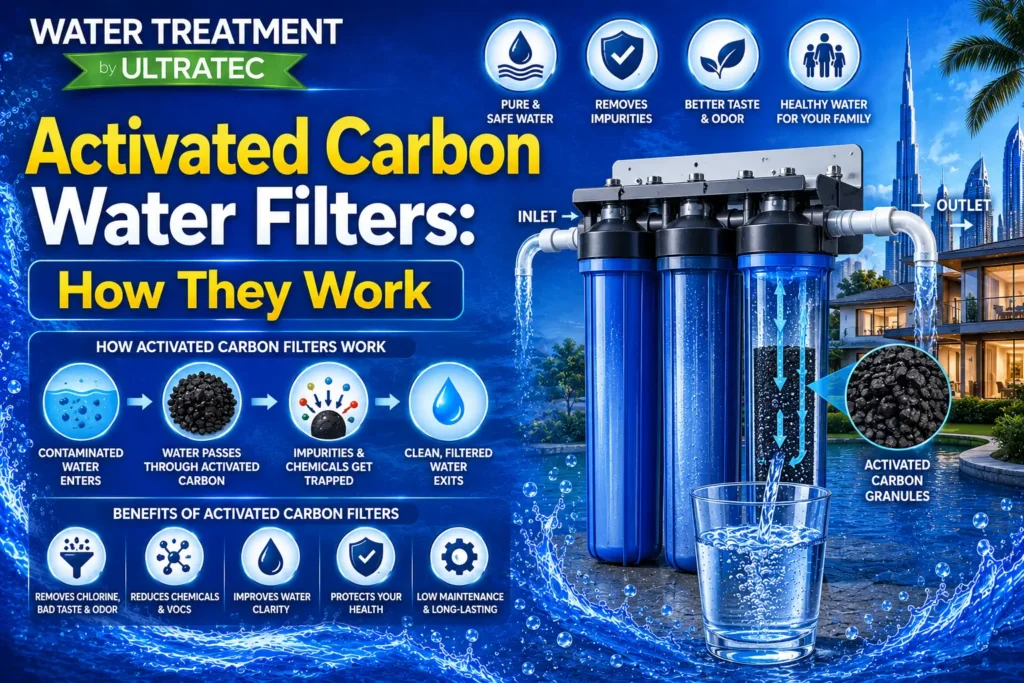
If you are considering residential water treatment, you’ve likely already encountered two key resources: our comprehensive Domestic Water Treatment guide, which outlines all aspects of Domestic Water Treatment guide, explaining how the whole-house treatment systems safeguard your entire water supply. Activated carbon water filters are a common feature in both technologies as a basic component.
This article focuses on the technical aspects of how it works, what it does, and its role in an overall domestic water treatment system.
Table of Contents
ToggleUnderstanding Activated Carbon Water Filter
Activated carbon water filters are made from highly porous carbon, usually processed from coconut shell, coal or wood, at high temperatures and in a low oxygen environment, significantly enlarging the carbon’s internal surface area. A gram of activated carbon may have over 1000 square metres of surface area, which means it has a very large capacity for adsorption.
Adsorption, which is different from absorption, refers to the chemical bonding of contaminant molecules to the carbon surface that results in their removal from the water that flows through the carbon. This is very different from mechanical filtration, which depends on the size of the particles that the filter can capture.
How Activated Carbon Filtration Works?
Dissolved organic compounds, chlorine molecules, and volatile organic compounds (VOCs) are attracted to the activated carbon surface by van der Waals forces and electrostatic attraction when water is passed through the activated carbon filtration system. The contaminants are absorbed by the porous carbon matrix and then the water stream is separated from the contaminants.
There are two major types of activated carbon used in residential treatment:
Granular Activated Carbon (GAC): loosely-packed granules of carbon through which water passes. GAC is regularly employed in whole-house tank based systems and filter housings for inline filtration. It has good flow rates but may eventually become channeled if not backwashed occasionally.
Carbon Block Filters: Carbon in the form of a solid block that has been finely ground. Carbon block filters provide a much tighter filter matrix, and they have a much greater contaminant reduction and hold-up. Carbon block media are the most common media for most quality activated carbon water filter cartridges used in an under-sink or whole house system.
What Activated Carbon Filters Remove
Activated charcoal filtration is very effective with a specific, and critically important, range of contaminants:
| Contaminant Category | Examples | Removal Effectiveness |
| Disinfection by-products | Chlorine, chloramines, trihalomethanes (THMs) | Excellent |
| Volatile Organic Compounds | Benzene, toluene, xylene | Excellent |
| Taste and odour compounds | Geosmin, 2-methylisoborneol (MIB) | Excellent |
| Pesticides and herbicides | Atrazine, lindane | Good |
| Some heavy metals | Lead, mercury (with catalytic carbon) | Moderate |
| Sediment (carbon block only) | Fine particles, cysts | Good |
Dissolved salts, nitrates, fluoride, hardness minerals and microbiological contaminants (bacteria and viruses) are not well absorbed by activated carbon. That’s why carbon filtration is employed nearly always as part of a larger multi-stage system.
Activated Carbon Water Filter Cartridge: Types & Specification
There are a number of technical parameters that, once chosen, make the filter cartridge suitable for a specific application:
Micron Rating: Carbon block cartridges are rated based on the smallest particle size the cartridge can actually physically trap. The 0.5-micron carbon block is capable of removing Cryptosporidium and Giardia cysts. A 5 micron cartridge will capture sediment and general taste/odour.
Contact Time: The longer the water is in contact with the carbon media, the more effective the adsorption will be. Reducing flow rates and extending filter beds further reduce contaminate reduction. In commercial systems, this is described as Empty Bed Contact Time (EBCT) and a minimum of 10 minutes EBCT is recommended to effectively remove chloramines.
Iodine Number (mg/g): An important characteristic of activated carbon. The higher the iodine number (900-1,100 mg/g) the more adsorption potential the carbon has and the longer time it takes before the carbon is saturated.
Carbon Source: Coconut shell derived activated carbon has the highest surface area and is most suitable for drinking water applications because it is pure and it performs on a consistent basis.
Where Carbon Filters Fit in a Whole-House System?
Whole house water filtration systems are a common point of entry system that features an activated carbon filter as a separate stage after the sediment pre-filter stage. The carbon stage is used in a multi-stage whole-house treatment system for two reasons:
- to remove the chlorine and chloramines that would degrade the membrane and UV lamp sleeve downstream,
- to enhance the taste and odour of water in any outlet within the house, not just drinking taps.
Catalytic activated carbon is becoming the preferred material over regular activated carbon for homes on municipal supply, as it is better able to remove chloramines—a disinfectant that is increasingly being utilized by water utilities and is partially removed by regular activated carbon. Many modern Domestic water treatment systems use activated carbon filtration as a key stage for improving residential water quality.
Service Life and Maintenance
An Activated Carbon (AC) filter will not last forever. When the adsorption sites on the carbon surface are all filled with contaminants, the media is saturated and contaminants will start to move through the media, known as breakthrough. The carbon has to be replaced, not regenerated, at this stage.
The normal life expectancy of a carbon block cartridge for home use is 6 to 12 months, based on water quality, water consumption, and chlorine level of the incoming water. Life of media in tank-based GAC systems in whole-house applications can be 3–5 years, allowing for periodic backwashing of the media to prolong the life.
It is practical to monitor the performance of the carbon stage and determine when it needs to be replaced by using a TDS meter or chlorine test kit at the outlet side of the carbon stage monthly.
Final Thoughts
Amongst all the technologies used for home water filtration, activated carbon water filters are one of the most scientifically proven and used technologies. Their unparalleled capability in the extraction of chlorine, chloramines, VOCs and taste and odour compounds makes them an essential step in any serious home filters either as a standalone cartridge filter or as part of a whole-house multi-stage filter.
FAQs
What activated carbon filters do remove?
It can effectively remove chlorine, chloramines, THMs, VOCs, pesticides and taste and odour compounds, but not dissolved salts, fluoride, hardness or bacteria.
What is the difference between GAC and Carbon Block filters?
GAC utilizes loose granules for whole-house tanks that require high flows; carbon block utilizes compressed media for point-of-use tanks to provide finer and more consistent contaminant reduction.
How frequently are the activated carbon water filter cartridges changed?
The life-time of a carbon block cartridge is between 6 to 12 months and a whole house GAC tank media life is 3 to 5 years with regular backwashing.
Is an activated carbon filter suitable as a stand alone water treatment system?
Yes, it (chlorine and odour removal) is good for chlorine and odour, but it should always be used in combination with other barriers (RO or UV) for complete drinking water safety.
What do you mean by catalytic activated carbon and when do you need it?
A treated carbon that will remove chloramines, not free chlorine; it is recommended when the water supply is chloraminated instead of free chlorinated.
Can activated carbon filtered water be used for borewell or groundwater?
It is capable of removing the organic compounds and pesticides from groundwater, whereas borewell water may need further treatment for TDS, hardness and microbial contaminants.
The Right Activated Carbon Filtration System for Your Home!
Each home will have a unique water quality profile and a properly sized activated carbon system will need to be matched to your specific home water analysis, flow requirement and treatment goals. When properly sized, a carbon stage filters out the chlorine that may be present in your water and safeguards your downstream RO membranes, prolongs the life of your UV lamp, enhances the quality of water at all of your outlets, and provides consistently safe, excellent tasting water throughout your house.
Water Treatment Company in UAE provides and mounts pro-fabriated activated carbon water filter systems for house, villa and apartment use in UAE. Our technical team will determine the water quality and suggest the filter system for your home that fits your requirements; such as a standalone activated carbon water filter cartridge replacement, a whole-house GAC system, or complete multi-stage domestic water filter system.
Call us today for a no-cost water quality consultation and personalised filter system recommendation..
To learn more about carbon filtration and fit it into a full home water treatment system, read our full Domestic Water Treatment Guide!
