
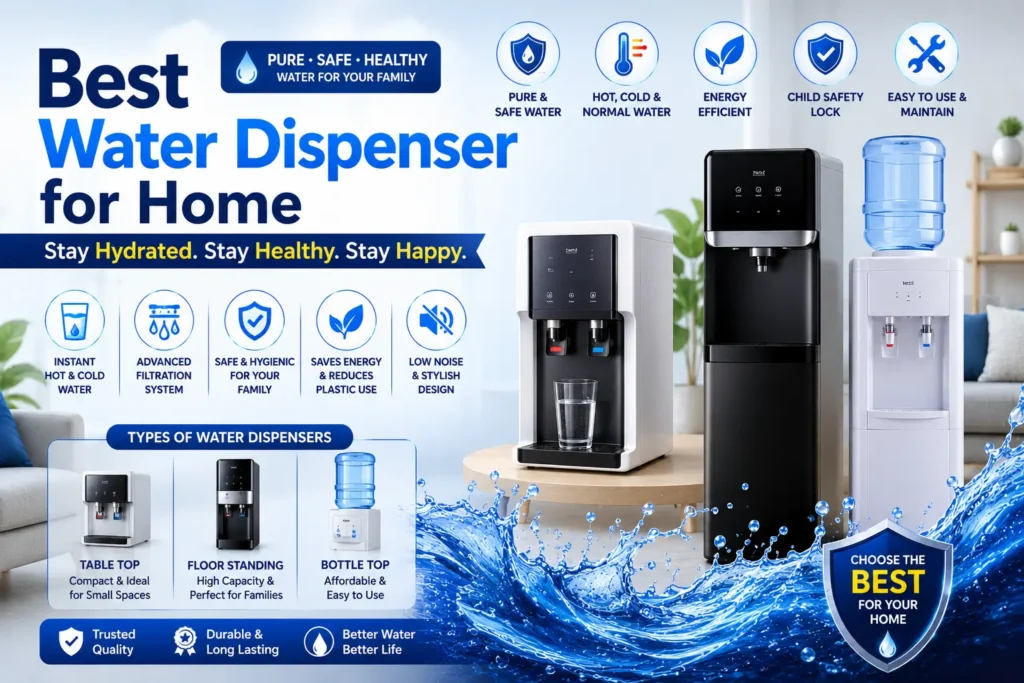
One of the best things to add to any home is a water dispenser that dispenses hot, cold or ambient temperature water instantly, without the hassle of boiling a kettle or waiting for your water to cool down. There are dozens of models available at all price ranges, however, to find the best water dispenser for home use, it is essential to know about the technology and what truly counts for everyday usage. If you are thinking about purchasing a water treatment system for your home, you should read our extensive Domestic Water Treatment: The Complete Guide to Safe Home Drinking Water to get a more in-depth look at the condition of the water in your home.
Table of Contents
ToggleHow Does a Water Dispenser Work?
Learning about the operation of a water dispenser can help you select the appropriate model. Most dispensers are either of the two types:
Bottle-Fed Dispensers consist of a large inverted bottle (usually 18-20 litre) which sits on the dispenser. Water can be drawn into an internal reservoir by gravity/air pressure, with independent heating and cooling systems to preheat/cool water as needed.
Bottleless (Point-of-Use) Dispensing Systems are attached to your home’s water supply line. Built-in filtration (sediment, carbon, and sometimes RO) is used to filter the water before dispensing. These are recommended for permanent domestic installations, as they are waste-free and remove bottle replacement costs.
Factors While choosing the best quality water dispenser
It’s not just the brand name that determines the best water dispenser. Some of the important parameters to consider are:
Cooling technology: Compressor based cooling system keeps temperature at 5-10°C all the time; thermoelectric cooling system is quieter and less effective in the UAE warm climate.
The ability of the pot to heat up: Minimum 90°C for safe hot beverage preparation.
Suitable tank capacity: Cold tank 3–5 litres; hot tank 1–2 litres will suffice for the majority of the families
BPA-free construction: Required in all units that come into contact with drinking water.
Energy saving mode: Dispensers will be on all the time and off-peak power reduction will significantly reduce running costs.
Hot and Cold Water Dispenser
The most common UAE household setup is the hot and cold water dispenser, which dispenses boiling water for tea/coffee and cold water for drinking, thus reducing the need for a separate kettle and a fridge filter. Child safety locks, leak detection and self cleaning UV or ozone filters that purify the internal tanks are also available on premium models – very important in the UAE’s warm climate as bacteria can proliferate in stored water.
Portable Water Dispenser
Portable water dispensers are perfect for small areas, rental properties, and areas that don’t allow the permanent installation of such a dispenser. Compact models with no plumbing and direct water connection to standard bottles are available; these are countertop models. A portable dispenser provides good flexibility at an affordable cost, for households moving frequently, or requiring a second unit for a study or bedroom.
How to Clean a Water Dispenser
Cleaning the water dispenser is an important step in ensuring water quality, especially in hot climates where the dispenser will be used every day, thereby increasing the risk of bacteria.
Frequency: every 6-12 weeks for bottle-fed units, every three to six months for bottleless dispensers.
Basic process: Drain and unplug the unit, clean drip tray and bottle cap, run a food-grade sanitising solution (e.g. diluted white vinegar or manufacturer approved sanitiser) through the food reservoir(s) and then flush with clean water, wiping all exterior surfaces. Built-in UV or ozone self-cleaning can decrease manual frequency, but will not completely eliminate manual cleaning.
Conclusion
The most suitable water dispenser for home is the one which suits the size of your home, space, and hot and cold water requirement per day. In most cases a compressor, hot and cold water dispenser with self-cleaning cycle and an energy saving feature is the ideal long term water dispenser for most families. To learn more about home water purification technologies available that can be used in conjunction with your dispenser, see our home drinking water treatment guide: Domestic Water Treatment: The Complete Guide to Safe Home Drinking Water.
Discover the Perfect Water Dispenser Today
Water Treatment Company UAE offers a selection of home water treatment systems ranging from hot and cold dispensers, portable water treatment units, and bottleless point-of-use water treatment systems, all designed to meet the water treatment requirements of UAE water conditions and climate.
Call Water Treatment UAE today and they will advise you on the best treatment for your home.
FAQs
Q1. Which is the best water dispenser for the home set up in UAE?
The ideal dispenser for most UAE households would be a compressor based hot and cold dispenser with BPA-free construction, child safety lock and an energy-saving mode.
Q2. Which is the highest quality water dispenser?
These are all features to consider in addition to brand, and include one that has compressor cooling, 90°C+ heating, BPA-free materials, self-cleaning function and energy efficiency rating.
Q3. What process is used to bring water out of a water dispenser?
Bottle-fed units connect to mains water and gravity and air pressure are used to provide water into the heated and cooled internal tanks, while with the bottleless units the mains water is filtered before it is used.
Q4. Why is there a difference between a hot and a cold water dispenser and a portable dispenser?
Hot and cold dispensers have larger tank capacity and full temperature ranges; portable dispensers are compact and can be mounted on a countertop, and are ideal for secondary locations or smaller spaces.
Q5. How many times should you clean your water dispenser?
Bottle-fed dispensers should be cleaned every 6 to 12 weeks, or as required by the manufacturer; point-of-use bottleless dispensers every 3 to 6 months, depending on the manufacturer’s recommendations, and filter changes should be done as directed by the manufacturer.
