
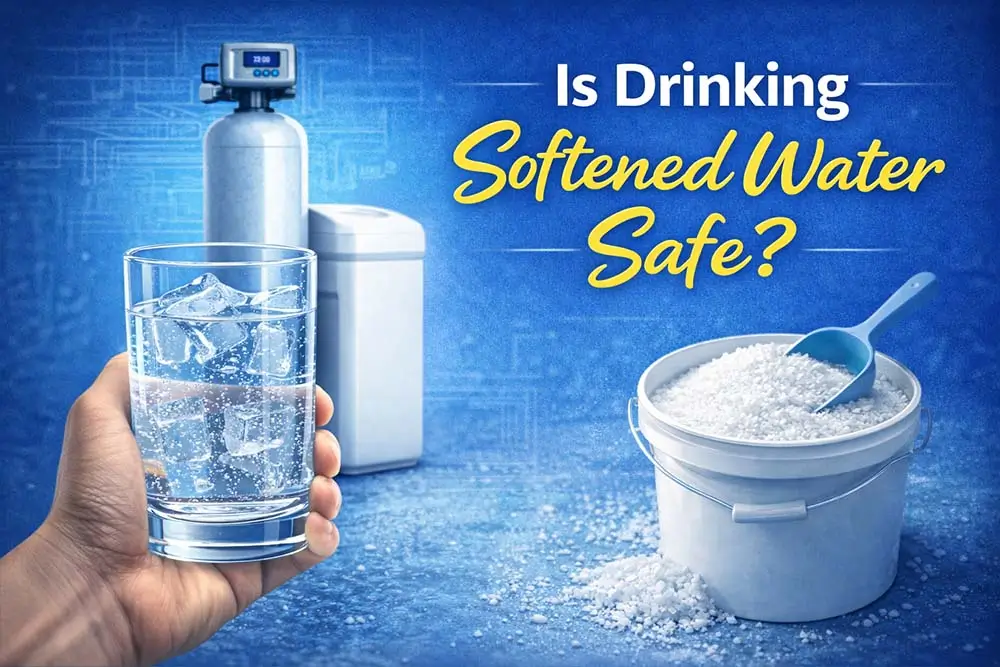
Is Softened Water Safe to Drink? A Comprehensive Guide to the Benefits, Risks and Considerations
Water softening is an extensive procedure which is frequently employed to enhance the quality of water by eliminating minerals such as calcium and magnesium. The minerals cause the hardness of water which deposits limescale in the pipes and appliances. However, the question is, is drinking softened water safe?
This blog will answer all your questions about drinking softened water, its advantages, disadvantages, and how it works, in order to make a good decision.
Softened Water vs Hard Water for Drinking
Aspect |
Softened Water | Hard Water |
| Hardness minerals | Removed | Naturally present |
| Taste | Smooth, sometimes slightly salty | Mineral-rich taste |
| Scale formation | No | Yes |
| Drinking use | Safe for most adults | Safe but mineral-heavy |
The key point here is that softened water is not harmful, but its mineral profile is different from hard water.
Health Effects of Drinking Softened Water
For healthy adults, drinking softened water does not usually cause any serious health issues. Concerns arise mainly for people who follow a low-sodium diet. Since some softeners are sodium-based, regular consumption may not be recommended for such individuals.
For children and elderly individuals, softened water is safe in most cases. However, if a medical condition is involved, using a separate drinking water solution is often a better option.

Is Softened Water Safe for Everyone?
User Category |
Recommendation |
| Healthy adults | Safe for drinking |
| Children | Generally safe |
| Elderly | Safe unless sodium-restricted |
| Heart patients | Doctor’s advice recommended |
| Low-sodium diet | Avoid regular use |
Because of these factors, many households use a water softener along with a separate drinking water filter.
What Exactly is Softened Water? Understanding the Process and Benefits
Softened water that has undergone an ion exchange process. In the process, calcium and magnesium ions which cause hardness of water are substituted with sodium ions. The result is “soft water” that is easier on pipes and household appliances.
Water softeners are normally applied in areas where people have hard water and the treatment aids in prolonging the life span of the plumbing and appliances as it is able to prevent the formation of a scale. The question is: Is softened water safe to drink?
Unveiling the Process of Water Softening: How it Works?
Water softening operates based on a process known as ion exchange. It goes like this:
- Resin Beads: Water is filtered through resin beads which are impregnated with sodium ions in a typical softening system.
- Ion Exchange: Calcium and magnesium in the hard water are replaced by sodium ions to convert the hard water to soft water.
- Regeneration: When the calcium and magnesium saturate the resin beads the water softener regenerates by flushing the beads with a salt solution (brine) to eliminate the calcium and magnesium ions and replace them with new sodium ions.
Understanding the Safety and Benefits of Drinking Softened Water
The advantages of using softened water are:
Deterrence of Limescale Deposition
One of the most significant advantages of consuming softened water is the avoidance of the deposition of lime in such appliances as dishwasher, water heater, or plumbing. This prolongs the life of the household appliances and minimizes the maintenance expenses.
Better Flavor
Softened water generally tastes better since it does not have the minerals that make the water have a metallic taste. This may result in tastier beverages and food cooked using water.
Enhances Appliance Performance
Since limescale is gone, water consuming appliances, like coffee machines and kettles, will be more efficient and have a longer life.
Potential Drawbacks of Using Softened Water: What You Need to Know
- High Sodium Content: The ion exchange process substitutes minerals by sodium ions, increasing the sodium content in softened water. This may be an issue to people who have high blood pressure or are on low-sodium diets. Nonetheless, there is usually low sodium content unless the softener is overused.
- Absence of Important Minerals: Softened water does not contain such useful minerals like calcium and magnesium that are essential to your health. Although these minerals are usually substituted by food, water is also a natural source of these minerals.
- Not for Babies: Softened water contains a lot of sodium, which may not be appropriate to babies under the age of six months because their kidneys are not well developed to absorb the sodium in large amounts.
Should We Drink Softened Water?
In the majority of adults, it is safe to drink softened water. Sodium is generally low and when you are on a balanced diet, the deficiency of calcium and magnesium is not an issue. Nevertheless, one should keep an eye on sodium consumption when you have a low-sodium diet as a result of some health issues such as hypertension or kidney disease.
In the case of infants and young children, softened water should be avoided as it contains more sodium, which might be dangerous to their developing kidneys.
Should I Take Softened Water? Key Takeaways
- Safe to the Majority: Softened water is typically safe to the majority of people and has some benefits like better skin, cleaner appliances, and enhanced cleaning ability.
- Take into Account Sodium Content: Individuals with high blood pressure or low-sodium diet should re-evaluate the consumption of softened water or find some potassium-containing options.
- Water Quality Matters: In case you worry about the absence or the presence of minerals or the existence of contaminants such as chlorine or heavy metals, then you should consider having a two-filtration system that will not only soften the water but will also employ reverse osmosis or carbon filtration.
- Environmental Impact: Although softened water can be used to decrease limescale and improve appliance performance, discharge of salt through conventional water softeners can have environmental effects which should be controlled.
Substitutes of Softened Water
Should you have any concerns as to the possible dangers of consuming softened water, there are a few options that you can have:
- Reverse Osmosis (RO) Systems: RO systems are more effective in the removal of sodium and other contaminants, so they are a safer choice of drinking water. RO systems are available to install in your kitchen sink to have clean drinking water.
- Distilled Water: This distillation process eliminates sodium as well as minerals, and thus, it is pure and clean water with no sodium added like in softened water.
- Whole House Filtration with Softening: A few whole-house filtration systems include softening in addition to filtration, hence the advantage of softened water and the elimination of contaminants.
The Bottom Line: Softened Water Is Generally Safe to the majority, but be aware of your Needs
To the people who query as to whether softened water is safe to drink, the answer is mostly yes. It has many household advantages and can be safe to a large percentage of the population. Nevertheless, more water filtration systems might be needed by those who have certain health issues or dietary requirements.
Drinking softened water is safe for most people, especially those who are not on a low-sodium diet. However, if you have high blood pressure, kidney disease, or young children, it’s best to consult with a healthcare provider before consuming softened water regularly. If you want to ensure the highest quality water, consider using reverse osmosis or distilled water for drinking.
For more information on water treatment services, including water softening and purification, explore wastewater treatment services in the UAE and optimize your home’s water system.
FAQs
Q1. Is it safe to drink softened water?
Yes, softened water is generally safe to drink for most people. However, those on low-sodium diets or with kidney disease should be cautious due to the increased sodium content.
Q2. Does softened water contain sodium?
Yes, during the softening process, sodium ions replace calcium and magnesium ions, increasing the sodium content of the water.
Q3. Can softened water cause high blood pressure?
Excessive sodium intake from softened water may contribute to high blood pressure for individuals who are sensitive to sodium. If you have high blood pressure, consult with a healthcare provider before drinking softened water regularly.
Q4. Is softened water safe for babies?
It is not recommended to give babies softened water due to the high sodium content, which may be harmful to their developing kidneys.
Q5. How can I remove sodium from softened water?
You can install a reverse osmosis system to remove sodium and other contaminants from softened water.
