
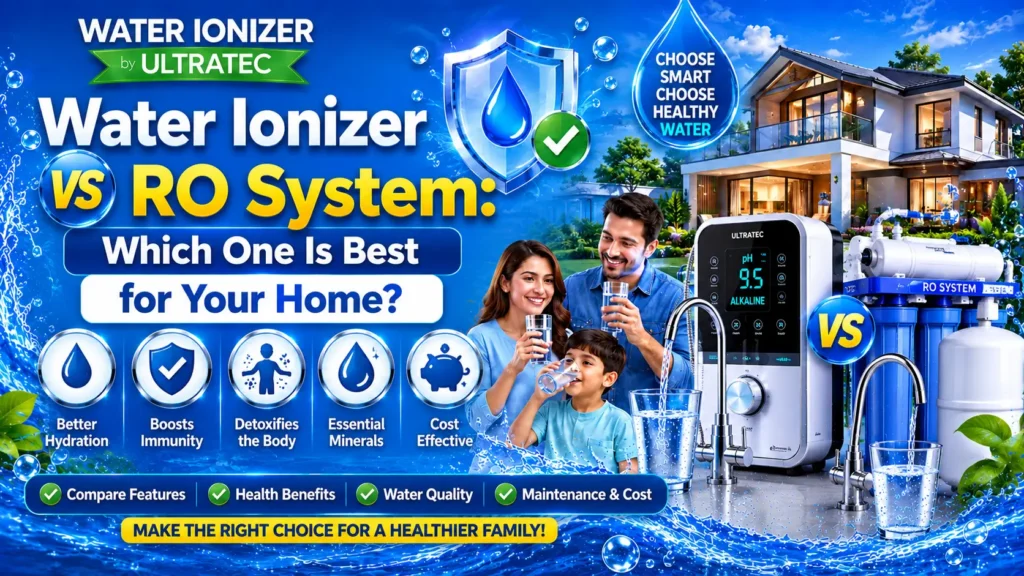
Two popular home water technologies have been compared and often misunderstood, such as two-way water ionizers and reverse osmosis (RO) water systems. They are not alternatives, they have different purposes. It is crucial to know the difference between water ionizer and RO so that you can make an informed decision on your home water setup. Before investing in any residential water treatment system, read our Domestic Water Treatment: The Complete Guide to Safe Home Drinking Water to get a complete overview of all residential water treatment technologies.
Table of Contents
ToggleWhat Is Water Ionization Process?
The water ionization process takes advantage of a technology known as electrolysis. In the ionizer unit, the water is split into two streams when it is passed through two platinum-coated titanium plates with an electric charge.
Alkaline ionized water: positive pH (8.0-9.5), negative ORP (antioxidant), smaller water clusters for increased hydration levels within the cells.
Acidic water: pH range: 4.0–6.5, for external uses: skin care, cleaning, surface disinfection
The water ionization process will not remove any dissolved contaminants, heavy metals or dissolved salts, but only will change the chemical properties of filtered or treated water.
How Does Reverse Osmosis Work?
A reverse osmosis system uses high pressure to push the water through a semi-permeable membrane, whose pores are 0.0001 micrometers in diameter. An effective rejection of dissolved contaminants such as salts, heavy metals, nitrates, fluoride and chlorine, resulting in the production of highly purified water, with dramatically reduced TDS.
RO systems neither improve water properties in a beneficial way (pH of permeate is slightly acidic, about 5.5–6.5) nor create antioxidant properties. They are for the purpose of purification and not enhancement. Shop our Purchase our Reverse Osmosis System here.
Water Ionizer vs RO System: Side-by-Side Comparison
| Feature | Water Ionizer | RO System |
| Primary function | Enhances water properties | Removes contaminants |
| Contaminant removal | Requires pre-filtration | Up to 99% removal |
| Alkaline pH output | pH 8.0–9.5 | Slightly acidic (5.5–6.5) |
| Antioxidant ORP | Negative ORP | None |
| TDS reduction | No | Significant |
| Heavy metal removal | No | Yes |
| Mineral retention | Yes | Removes minerals |
| Best used for | Health optimisation | Water purification |
How to compare water ionizers and understand their differences
Contaminant Removal
This is the biggest difference that can be applied through any water ionizer comparison. An RO system takes out an ioniser. A water ionizer cannot clean up contaminated water, it requires pre-filtered or treated water to work properly. So a water ionizer machine is perfectly safe for use in the UAE where the tap water is treated to meet the standards of the municipal water supply.
Mineral Content
RO systems can help to deplete the beneficial minerals calcium, magnesium and potassium in the water as well as the harmful contaminants, and thus produce so-called demineralised water, which needs to be remineralised. Water ionizers help to retain these minerals and re-energize them into a more bioavailable ionic form, a great plus for those seeking to boost their health.
pH and Antioxidant Value
RO water is slightly acidic or neutral. The alkaline water produced is always alkaline and possesses negative ORP properties which cannot be created by any normal filtering method, including RO. If you are looking to get the benefits from alkaline water, then only an ionizer can give you these benefits.
Running Costs
Membrane & filter in RO systems has to be replaced every 6 months – 5 years. Ionizers do not need to be cleaned at any cost to the membrane, and the pre-filter is replaced periodically at no cost, thus minimizing consumables’ expenditure.
Apply both at the same time: The Best Approach
It is not a reason to choose one or other, it’s a reason to combine water ionizer and RO. Many homeowners in UAE use an RO system for the purposes of removing contaminants to their homes and then use a water ionizer to add back in the purified water the alkalinity, antioxidant properties and enhanced hydration. These two provide the purest optimised water for residential use that is available.
Conclusion
The best answer to the water ionizer vs reverse osmosis debate is to realize that they are perfect complements to each other. RO can achieve purity, while ionization can achieve enhancement. They are the most comprehensive home water system available combined. See our Domestic Water Treatment: The Complete Guide to Safe Home Drinking Water for a detailed explanation of each residential water treatment technology.
Improve the water system in your home today!
If you’re looking to integrate ionization into an already installed RO system or start a new system for your home, Water Treatment UAE can provide the solutions and expertise you need to get the job done.
Contact water treatment UAE today, or shop directly
Professional installation and after-sales support available across the UAE.
FAQs
Q1. Explain the water ionization process?
Electrolysis separates the water between the plates into alkaline ionized water to be used in the internal system and acidic water to be used externally.
Q2. What is the difference between water ionizer and RO?
They are different uses, because an RO removes impurities, a water ionizer gives the water a better pH and antioxidant value, and provides better hydration.
Q3. Can a water ionizer replace an RO system?
No, an ionizer cannot remove contaminants, and should always be used with pre-filtered or treated water, not as a substitute for water filtration.
Q4. Does RO water benefit from ionization?
Yes, the RO removes the alkalinity and antioxidant ORP from the water, and passing it through an ionizer is capable of restoring it.
Q5. Is a water ionizer for home use suitable for UAE tap water?
Yes, the water from the UAE municipalities can be used for ionization, especially when preceded by a carbon or sediment pre-filter.
