
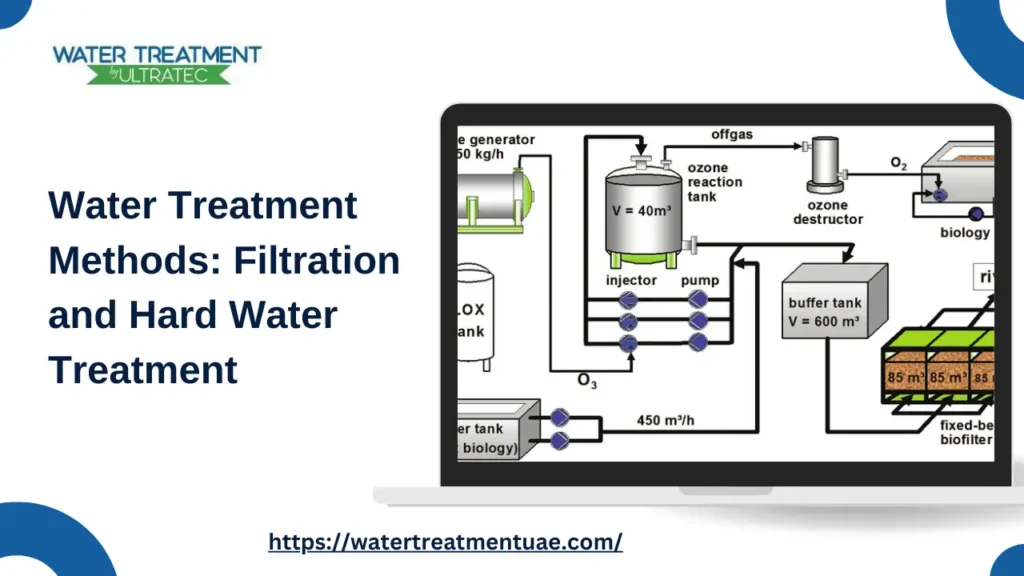
Water quality issues don’t always appear serious. Water might appear clear but still cause scale, odor, and equipment damage. That is where effective water treatment methods come in. In practice, most water processing plants rely on two basic approaches: filtration in water treatment and hard water treatment. They sound similar, yet they address different challenges. One eliminates particles. The other works with dissolved minerals. Understanding the distinction is important when picking a system.
Introduction to Water Treatment Methods
There is no uniform solution when selecting water treatment methods. The process depends on what is present in the water. Certain systems concentrate on suspended solids. Others are intended for dissolved salts or hardness. In many cases, treatment systems integrate multiple types of water treatment methods to reach the desired outcome. The goal is to match the solution to the problem. Businesses often rely on complete water treatment solutions to combine filtration, softening, and membrane technologies into one integrated system.
What Is Filtration in Water Treatment?
Filtration in water treatment refers to the removal of visible or suspended particles from water. It does not usually remove dissolved minerals. Instead, it targets silt, rust, sand, and organic matter. When hazy water passes through a filter, it clears up.

Purpose of Filtration in Water Treatment
The main purpose of filtration in water treatment is to improve clarity and protect equipment.
Filtration helps to:
- Reduce turbidity
- Protect pumps and membranes
- Improve taste and odor
- Prepare the water for further treatment
In most water processing plants, filtration is one of the first stages.
Common Filtration Materials Used
Depending on the application, filtration systems may contain a variety of materials and filtration parts and accessories designed to improve efficiency and extend system life. Sand is used to trap larger particles. Activated carbon is used to remove organic chemicals as well as chlorine. Membrane materials are utilized for finer separation. Each material has a specific function in different filtration methods in water treatment.
Types of Filtration Methods in Water Treatment
Different filtration methods in water treatment are selected depending on the application.
Sand Filtration Method
Sand filtration is a well-established water treatment method. Water moves through layers of graded sand. Suspended particles get trapped within the media. Backwashing removes collected solids from the filter over time. This approach is commonly employed in municipal and industrial pre-treatment systems.
Activated Carbon Filtration
Activated carbon filtration concentrates on eliminating organic chemicals, chlorine, and unpleasant tastes or odors. Carbon’s porous structure attracts and retains certain pollutants. This approach is widely used in commercial and drinking water systems.
Membrane Filtration (RO/UF)
Membrane systems advance filtration in water treatment. Ultrafiltration (UF) eliminates bacteria and tiny suspended particles. Reverse osmosis (RO) eliminates dissolved salts, hardness, and microscopic pollutants. Membrane filtration is crucial in many UAE-based water processing plants due to salinity and mineral content challenges.
What Is Hard Water Treatment?
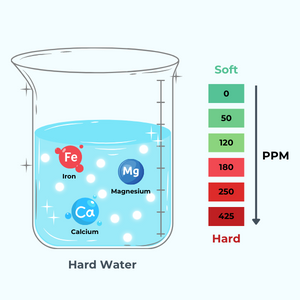
Hard water treatment addresses a separate issue. Hardness is caused by dissolved calcium and magnesium. These minerals do not make water dangerous, but they create operational problems. White scale formation in kettles or pipes is a common sign of hardness.
How Hard Water Is Identified
Hard water is frequently identified by:
- Scale deposits on fixtures
- Reduced soap performance
- Laboratory hardness testing
Hardness is common in groundwater systems and requires proper hard water treatment.
Problems Caused by Hard Water
Hard water can lead to:
- Scaling inside pipelines
- Lower heat transfer efficiency
- Increased maintenance costs
- Premature equipment wear
Hard Water Treatment Methods
There are several hard water treatment methods available, depending on the system size and application.
The Ion Exchange Method
The ion exchange method is commonly used for hard water treatment. Resin beads within the softener replace calcium and magnesium ions with sodium ions. This inhibits scale formation and protects equipment. This technology is commonly used in residential villas and commercial buildings.
Lime Softening Process
Lime softening is commonly utilized in large water processing plants. Lime is used to chemically react with hardness minerals, causing them to precipitate and settle. This method is primarily used in municipal-scale operations.
Reverse Osmosis for Hard Water Treatment
Reverse osmosis can also be used for hard water treatment. Unlike traditional softeners, RO eliminates dissolved salts, including hardness minerals. This approach is often used in industrial systems where low TDS levels are required.
Difference Between Filtration and Hard Water Treatment
Filtration in water treatment removes suspended solids. Hard water treatment removes dissolved minerals. They address different contaminants. Many systems combine both to provide complete water conditioning.
Choosing the Right Water Treatment Method
Proper water analysis is necessary before selecting the appropriate water treatment method.
You should know:
- Total dissolved solids (TDS)
- Hardness level
- Suspended solids
- Intended use
Conclusion
There is no single solution when it comes to water treatment methods.mFiltration in water treatment increases clarity and removes suspended particles. Hard water treatment removes dissolved minerals, preventing scaling. The appropriate system depends on the water quality and application requirements.
FAQs
What are some popular water treatment methods?
Sand filtration, activated carbon filtration, membrane systems, ion exchange softening, and lime softening are some of the most commonly used water treatment methods.
What is filtration in water treatment?
Filtration in water treatment uses sand, carbon, or membrane media to remove suspended particles from water.
What is hard water treatment?
Hard water treatment removes dissolved calcium and magnesium to prevent scaling.
What are the types of water treatment methods?
Types of water treatment methods include physical filtration, chemical softening, and membrane separation.
Can filtration reduce hardness?
No. Filtration in water treatment removes suspended particulates, while hard water treatment is required to remove dissolved minerals.
