
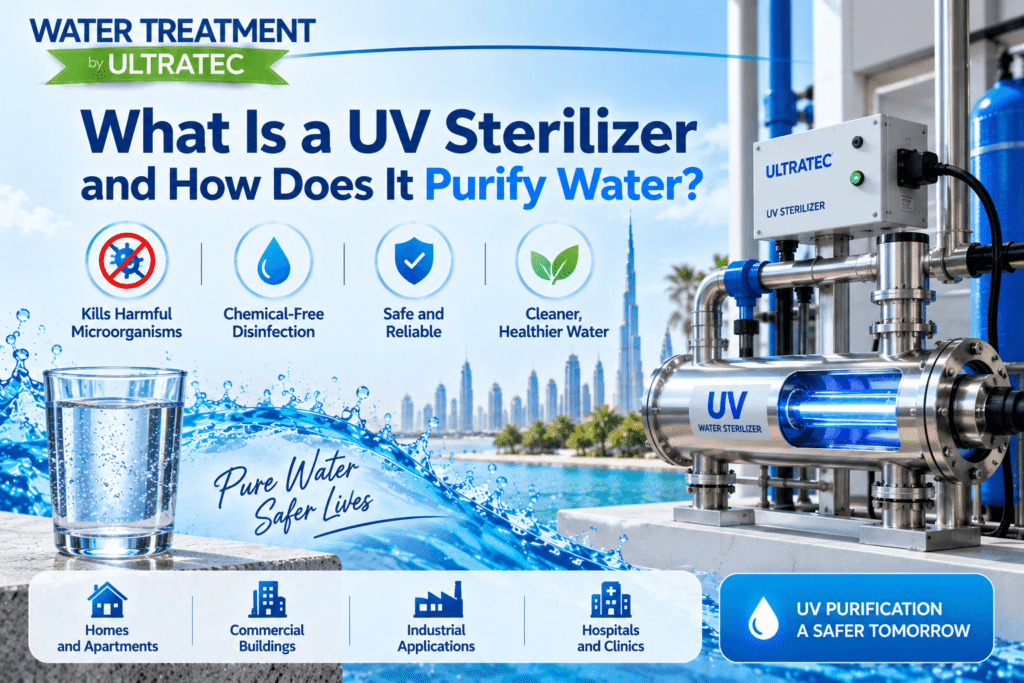
A UV sterilizer is a water disinfection system that uses ultraviolet light to inactivate bacteria, viruses, and other microorganisms present in water. Unlike chemical disinfection, UV treatment does not add chemicals to the water or change its taste and pH.
UV systems are commonly used in homes, commercial facilities, drinking-water systems, RO plants, and industrial water-treatment applications where microbiological control is required. Providers such as Water Treatment UAE supply and integrate UV disinfection units as part of broader filtration and RO setups, helping ensure treated water remains microbiologically safe before it reaches the point of use.
Table of Contents
ToggleWhat Is a UV Sterilizer?
A UV sterilizer disinfects water via a UV lamp enclosed within a chamber. To provide UV light, the lamp generates ultraviolet photons at germicidal UVC wavelengths. This light damages the genetic content of microorganisms.
Microorganisms fail to reproduce effectively or stay active after their DNA or RNA receives damage. UV treatment serves as an effective procedure to eliminate biological contamination in water.
| Feature | UV Sterilizer |
| Main purpose | Water disinfection |
| Treatment method | Ultraviolet light |
| Main target | Microorganisms |
| Chemicals required | No |
| Effect on taste | Does not normally change taste |
| Common use | Residential, commercial and industrial water |
How Does a UV Sterilizer Work?
The working principle of a UV sterilizer is very straightforward. When water leaves the UV chamber, it passes above an ultraviolet lamp which is held inside a protective enclosure. UV light produces a specific dose that kills microorganisms as water moves through the light. Ultraviolet light corrodes their internal DNA structure, stopping them from growing and staying alive. After treatment in the chamber, the water heads out toward the designated point where it will be used.
The process efficiency relies on key variables including ultraviolet irradiation strength, period of light exposure, water movement rate, and water opacity. Excessive suspended particles in the water serve as a protective shield against UV light for microorganisms.
| Step | What Happens |
| 1. Water enters | Untreated water flows into the UV chamber |
| 2. UV exposure | Water passes around the UV lamp |
| 3. Microbial damage | UV light damages microorganisms’ DNA/RNA |
| 4. Disinfection | Microorganisms are unable to reproduce normally |
| 5. Treated water exits | Disinfected water continues through the system |
UV Water Sterilizer Explained: Main Components
A UV water sterilizer consists of various key parts. Ultraviolet light disinfects using the UV lamp, while the quartz sleeve guards the lamp against water contact.
Inside the reactor chamber, which holds the lamp, water circulates it. The power supply to the lamp operates through an electrical ballast, and this device ensures correct operating conditions.
| Component | Function |
| UV Lamp | Produces germicidal UV light |
| Quartz Sleeve | Protects the lamp from water |
| Reactor Chamber | Holds the lamp and provides the treatment space |
| Ballast | Controls electrical power to the lamp |
| Control System | Monitors operation on equipped models |
What Is the Function of a UV Sterilizer?
The primary function of UV sterilizers is to eliminate waterborne microorganisms through a final disinfection process. Because it acts as microbiological protection, it is excellent for use with water that has already undergone filtration or some other treatment method and requires disinfection prior to its arrival at the final end-point.
UV technology serves diverse applications, including potable water treatment and process water treatment, along with commercial water treatment systems as well as integration into large-scale industrial treatment plants of large scale.
Where Are UV Sterilizers Used?
UV installations are used across many water treatment systems.
Residential water treatment: Household filtering systems can benefit from added UV treatment to attain better microbial protection.
Commercial buildings: UV disinfection provides water treatment solutions for hotels, offices, restaurants, and other facilities.
RO systems: Following membrane treatment, RO systems can use UV as a secondary disinfection step because of their specific system arrangements.
Food and beverage: The production and processing plants that use water require secure microbial standards.
Pharmaceutical and laboratory applications: UV provides essential microbiological protection for treated water in these applications.
Wastewater reuse: The last step of wastewater reuse treatment makes use of UV disinfection for pathogen elimination.
Benefits of UV Water Sterilization
UV treatment is highly beneficial because it disinfects water without requiring chemical disinfectants. The UV chamber disinfects water efficiently because it passes through rapidly.
The system boasts compact installation capabilities and simple operation requirements and produces treated water without chemical residues. The treatment system operates quickly and requires easy maintenance.
Since UV only functions as a disinfection method, you should use it alongside a full filtration system. Dissolved salts, hardness, sediment, and other physical contaminants are not removed by this method.
Does a UV Sterilizer Remove All Contaminants?
No, this has significant delivery implications for water systems. Ultraviolet light is effective primarily in deactivating microorganisms. It cannot substitute for the functions of an RO membrane, sediment filter, or activated carbon filter.
| Treatment System | Main Purpose |
| UV Sterilizer | Microbial disinfection |
| RO System | Reduces dissolved salts and many contaminants |
| Sediment Filter | Removes suspended particles |
| Activated Carbon | Reduces chlorine, odour, and certain organic compounds |
| Water Softener | Reduces hardness-causing minerals |
Does a UV Sterilizer Need Maintenance?
Yes. Maintenance on a regular basis keeps ultraviolet performance functional. To ensure proper UV light transmission, the quartz sleeve must be free from dirt deposits or fouling. UV lamps possess specific operational lifespans during which they need to be replaced as indicated by manufacturer requirements.
Water pretreatment is as vital as the rest of the process. The general practice before UV treatment is to employ filtration when feedwater contains substantial turbidity together with massive suspended particles.
Is UV Sterilization Safe for Drinking Water?
As long as a drinking-water system is appropriately designed and sized and properly maintained, UV disinfection remains a common water treatment method. In order to determine proper UV system selection, the critical elements include required UV dose, water flow rate, and water quality combined with equipment condition. A proper UV system should be chosen based on actual application requirements instead of sizing a lamp solely according to its physical dimensions.
Final Thoughts
A UV sterilizer provides a straightforward way to control microorganisms in water without adding chemicals. It works by exposing flowing water to ultraviolet light, which damages the genetic material of microorganisms and prevents them from reproducing.
For residential, commercial, and industrial applications, UV can be an effective part of a wider water-treatment system. The best results come when the UV unit is correctly sized and supported by suitable filtration and regular maintenance.
FAQs
What is a UV sterilizer?
A UV sterilizer is a water-disinfection device that uses ultraviolet light to inactivate microorganisms such as bacteria and viruses.
How does a UV sterilizer work?
Water passes through a chamber containing a UV lamp. The ultraviolet light damages microorganisms’ DNA or RNA, preventing normal reproduction.
What is the function of a UV sterilizer?
Its main function is microbial disinfection. It helps control biological contamination without adding chemical disinfectants.
Does UV sterilization remove bacteria?
UV can inactivate bacteria when the system provides the required UV dose and operating conditions.
