
If you have been shopping around for residential and marine water treatment solutions, then you have most likely heard of our extensive Domestic Water Treatment: The Complete Guide to Safe Home Drinking Water that provides you with a complete list of all the water treatment options out there for residential use, and our guide to Best Whole House Water Filter Systems for Home in which we outline point-of-entry water filtration for the whole house. When water is not available, offshore vessels, remote coastal properties, islands and desert facilities are a whole new class of technology: the water maker.
In this article, you will gain an understanding of what a water maker is, how the water maker process works, the various types of water maker systems that are available, and the ability of a water maker to produce safe drinking water.
Table of Contents
ToggleUnderstanding Water Maker
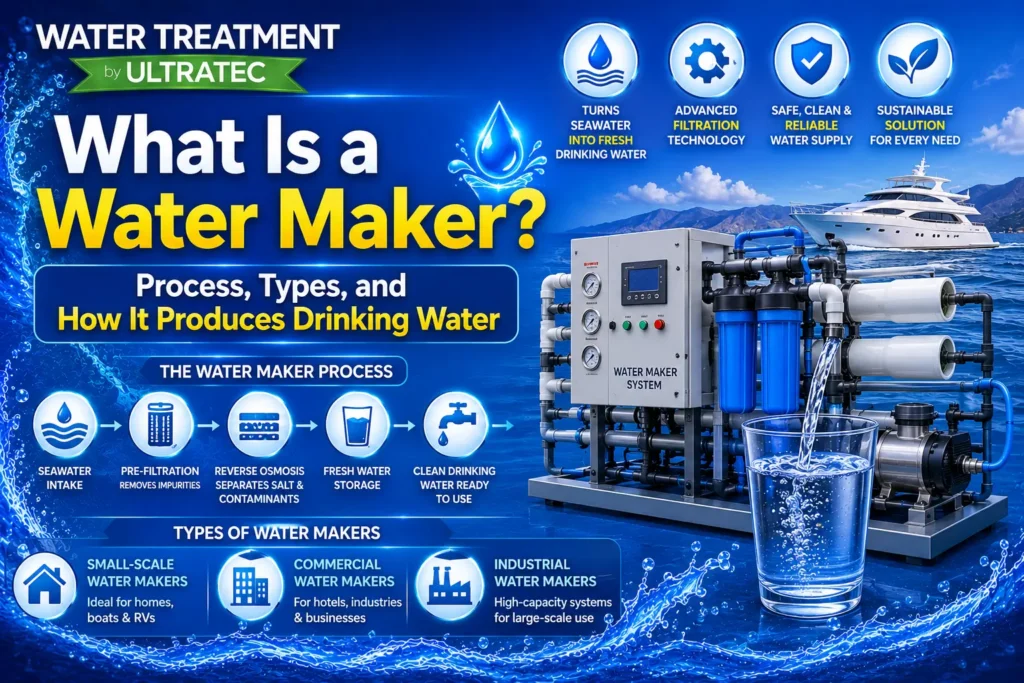
A water maker system is a desalination machine that transforms saline water most commonly seawater to fresh potable water by means of a membrane separation process. It is employed on a broad scale in marine, offshore and remote residential projects where access to a municipal water supply is not available or feasible.
The most important technology incorporated in practically all modern seawater water makers is called Reverse Osmosis (RO). This technology is the same used in the residential under-sink RO system, but designed to handle the much greater salt concentration and osmotic pressure of seawater. Along with water makers, other home water treatment systems such as RO units, UV purifiers, and whole house filters help improve water quality.
The Water Maker Process Explained
The process of the water maker is composed of a series of treatment processes that are intended to safeguard the high pressure RO membrane and generate potable water.
Stage 1: Raw Water Intake Seawater or brackish water is pumped into the system using an intake line that is fitted with a coarse strainer to filter out large particles, marine life and sediment. This intake is usually below the water level in marine use and a coastal borewell or open channel intake is land based.
Stage 2: Pre-Filtration The raw water goes through a multi-stage pre-filtration process, usually a sediment cartridge filter (20-50 micron) and a polishing filter of finer size (1-5 micron). This stage will eliminate suspended solids and turbidity which would foul or abrade the RO membrane surface physically.
Stage 3: High-Pressure Pumping A high-pressure pump pressurises the pre-filtered seawater to between 55 and 80 bar (800–1,200 psi) the pressure required to overcome the natural osmotic pressure of seawater, which is approximately 27 bar. This is the most energy consuming part of the water maker process.
Stage 4: RO Membrane – The pressurised seawater is pushed through a semi-permeable RO membrane. The fresh water (permeate) goes through the membrane, while the salts, minerals and contaminants get rejected and are expelled as concentrated brine. High quality seawater RO membranes can remove salt at 99.0 – 99.8%, resulting in water having TDS of less than 500 mg/l, well below WHO potable water guidelines of 1,000 mg/l.
Stage 5: Post-Treatment – The RO membrane permeate water is slightly acidic and devoid of minerals. Post-treatment technologies are generally activated carbon polishing (to eliminate any taste), remineralisation (to restore the pH and mineral balance) and UV disinfection (to guarantee microbiological safety before consumption).
Types of Water Maker System
There are the following types of water maker systems:
Seawater Maker (SWRO) A seawater maker is designed for open ocean or seawater from coastal areas that has a salinity of about 35,000mg/L (35ppt). It needs high pressure pumps and membranes that are designed for full seawater salinity. SWRO systems are widely used on ships operating offshore, island resorts and coastal desalination facilities.
Brackish water RO System, such as estuarine water, lower salinity borewell water in the vicinity of the sea, brackish water RO systems run at relatively lower pressures (10-20bar) and lower energy consumption when compared to full seawater systems. The system category is based on the TDS in the water source.
Portable and Compact Water Makers For sailing yachts, small vessels, emergency and off-grid. Compact water maker systems are smaller versions of the water maker systems, which are designed to generate 30 to 200 litres of water per hour and have minimal power consumption requirements and installation space requirements in the confined areas in which they operate.
Modular Industrial Water Makers, containerised or skid-mounted modular seawater desalination systems with a daily capacity of thousands of cubic metres (TDM) for use in island communities, military bases, hotel resorts and industrial facilities in water-scarce coastal areas.
Is it Possible for a Water Maker to Generate Drinking Water?
Absolutely, a well-designed and well-maintained water maker system makes safe drinking water. The core of the system is the RO membrane which removes dissolved salts, heavy metals, bacteria and viruses and virtually all dissolved contaminants to the level required by the WHO and international potable water standards.
But there are three conditions that must be met for the product to be safely produced for drinking:
- Adequate Pre-Filteration, It is essential that there is sufficient pre-filtration to ensure that the integrity of the membranes is maintained. When a membrane is damaged or contaminated, it allows contaminants to pass through.
- Post-treatment stages particularly UV sterilisation and remineralisation should be included. UV treats for microbiological safety, after the membrane, RO permeate is low in pH and minerals.
- Regular Maintenance. Membranes deteriorate with age, high pressure seals leak and pre-filters become water-soaked. If a water maker cannot be maintained and verified by current maintenance, then it is not considered safe to drink without testing.
Under these parameters, the water maker produced water is generally of a better quality than most tap water supplies, when measured in terms of measurable TDS and microbiological levels.
Conventional Domestic Water Treatment vs. Water Maker Systems
| Parameter | Water Maker (SWRO) | Whole House Filtration + RO |
| Source water | Seawater / brackish water | Municipal / borewell supply |
| Operating pressure | 55–80 bar | 3–8 bar |
| Primary purpose | Freshwater generation | Water quality improvement |
| Salt removal | Yes (from saline source) | Yes (from low-salinity source) |
| Application | Marine, offshore, remote | Residential, domestic |
| Energy consumption | High | Low–moderate |
For homes that are on a municipal supply, the whole house filtration system and point of use RO system, as described in our Domestic Water Treatment guide, is still the best and most economical choice. Water maker is the right technology when there is no source of freshwater available.
Water Maker System Maintenance Requirements
- Replace pre-filter cartridge at 200–500 hours of operation.
- Replacement of RO membrane every 2-5 years, depending upon the quality of feed water.
- Annual inspection of pump seal and pump valves under pressure.Annual inspection of pump seal and pump valve at high pressures.
- Replace UV lamp 1 time per year
- Taking the membrane out of the water during long lay-up periods to prevent biological fouling, by pickling (preservation) the membrane.
- Fresh water flushing after seawater use to minimize scaling and biofouling problems
FAQs
What does it mean to be a water maker?
A water maker is a device that desalines seawater or brackish water using a reverse osmosis process to make fresh potable water suitable for marine, offshore or remote use.
What is the process of water maker?
The raw seawater is pre-filtered, pressurised to 55-80 bar and then passed through an RO membrane which removes the salt and contaminants, leaving the fresh permeate water with up to 99.8% salt rejection.
What are the types of water maker systems?
They can be broadly categorized as seawater RO (SWRO) for seawater sources, brackish water RO (BWRO) for sources with lower salinity, compact marine water makers for marine vessels, and large modular systems for island or industrial applications.
Can water be made into drinking water?
Yes, if pre-filtered and then treated with a UV system, water made by the water maker can be potable water as long as it is maintained regularly.
Choose the Right Water Maker System for Your Application
For whichever seawater water maker, either a marine vessel model or a brackish water RO system, or a modular desalination unit for a coastal facility, the required system must match exactly the salinity of the seawater source, the daily production demand, the available electrical supply and space limitations.
Water Treatment UAE offers water maker systems design, supply and installation services in UAE for marine, offshore, residential and commercial applications. Our technical team performs source water analysis and delivers an all engineered system specification for consistent, safe drinking water production from the start.
Call us today to schedule a free technical consultation and water maker system recommendation that’s specific to your application.
Read our complete Domestic Water Treatment Guide to learn how RO technology is used to drive water makers and home water treatment systems.
If you have access to a municipal water supply or borewell, check out our Whole House Water Filter Systems guide.
