
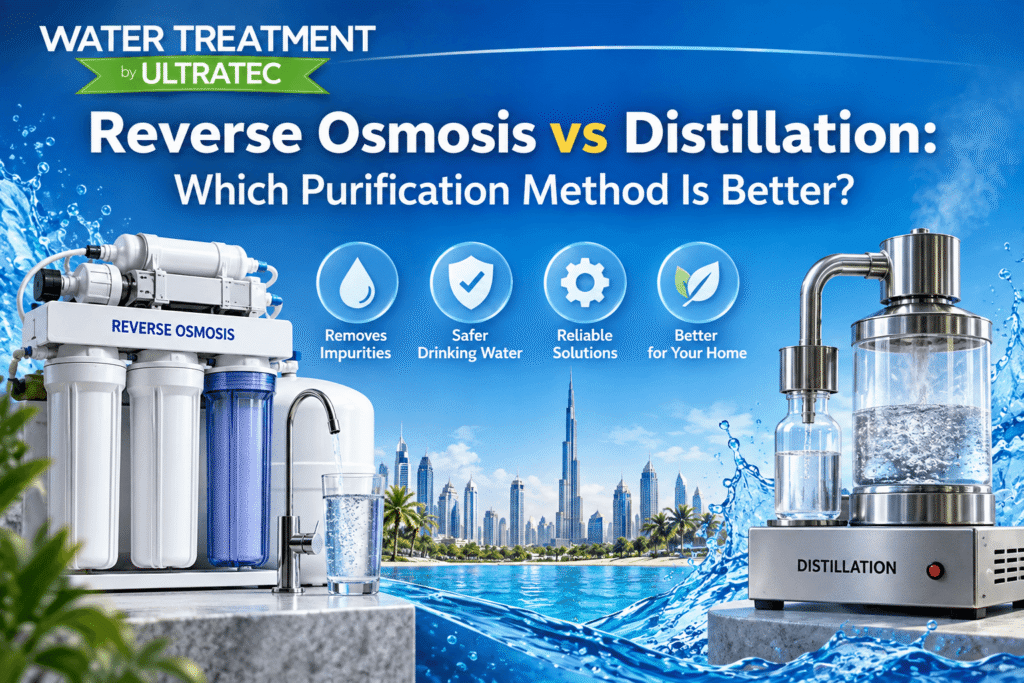
When people compare reverse osmosis vs. distillation, the two methods can seem almost identical at first. Both are used to produce highly purified water, and both can reduce many unwanted substances. The difference is in how they achieve that result.
Reverse osmosis uses pressure to push water through a semi-permeable membrane. Distillation uses heat to turn water into steam and then condenses that steam back into liquid.
That difference affects energy use, production speed, installation, maintenance, water quality, and everyday practicality. So, which method should you choose? The answer depends on how you plan to use the water and what you need the purification system to accomplish. This guide from Water Treatment breaks down both options so you can decide with confidence.
Table of Contents
ToggleWhat Is Reverse Osmosis?
Reverse osmosis, generally referred to as RO, represents a water purification technique using membranes. The water passes through a semipermeable membrane in an RO system by means of applied pressure. The membrane permits the flow of water molecules and eliminates a substantial amount of dissolved minerals and contaminants. Several stages make up a residential RO system. The two filtering units of sediment and carbon usually go in front of the RO membrane, both to safeguard the membrane and raise the efficiency of treatment. Systems sometimes handle water with a post-filter or with remineralization after the RO membrane.
The biggest advantage of RO operation is its ability to generate clean water nonstop without heating the full amount of water at once. There are modern RO systems designed to serve residential properties as well as commercial service locations and industrial water-treatment facilities. Systems of large size become custom-built based on the specifications of feed-water history and treatment goals in addition to requested capacity.
What Is Distillation?
A completely different mechanism exists at the heart of water distillation. Heating water in a distiller causes it to reach an evaporation point. Residues of non-volatile contaminants, combined with minerals plus dissolved solids accumulate while water undergoes steam formation. After leaving the heating area the steam moves through the cooling section where it turns back to liquid water. The final outcome is water that contains slimy minimal minerals.
Heating functions as the key component for distillation operations provided the process involves boiling and condensation methods. Distillation produces extremely low-mineral water efficiently for requirement-based applications but the thermal demands increase significantly when you need to suppress large volumes of water. People use distillation water purifiers mainly for particular purification purposes instead of routine domestic large-capacity water treatment.
Reverse Osmosis vs Distillation: How Are They Different?
The most basic explanation for understanding the difference is to study the purification process. Reverse osmosis functions by pushing water through a semi-permeable membrane.
Distillation: Steam is created when water is heat treated before being converted into liquid again. Both techniques achieve high quality water purification but they each need different operational specifications. RO works based on two factors that are pressure and membrane separation. Distillation requires these three steps: heating then evaporation followed by condensation.
What Contaminants Can They Remove?
Both reduction systems can be used for many contaminants though their operation methods differ. RO achieves optimal performance in lowering total dissolved solids and dissolved salts content in water. Different system designs along with membranes offer the ability to remove numerous metals and micro-organisms as well as additional contaminants. During the evaporation process distillation enables non-volatile elements to remain in the original substance. The mineral content for distilled water remains extremely low because minerals and salts don’t normally move alongside the steam.
For cleaning water contaminants we must recognize organotellurium compounds as specialized chemicals which universities have limited comparable investigative methods. Pollutant elimination results from the synergy between filtration equipment and specific contaminant parameters including operating conditions. RO systems demand pre-treatment before operation. The performance of the membrane depends on the entire treatment system because suspended particles and chlorine and other substances change how well the membrane functions.
RO vs Distillation for Drinking Water
For regular drinks of water the practical convenience separates itself as equals with purification power. An RO system delivers treated water from either a specific kitchen faucet or storage reservoir. Many residential systems function by creating water continuously and by demand.
Distillers function using a batch process. The heating and condensation procedure must be completed before the water is ready for use. The extended use time at multiple times during the day makes RO systems especially effective for homes with several users requiring purified water.
Taste matters too. RO water can undergo a remineralization phase after purification point depending on its system design. By using this approach systems can reintroduce selected minerals into water while delivering taste modifications and overall profile adjustments. Distilled water contains extremely low mineral levels producing a flavor described as distinctly neutral or flat.
Which Uses More Energy?
They use this as a major differentiator between these two technologies. Through distillation, we can evaporate water that demands heat. Steam generation requires vast amounts of thermal heat and this can cause energy requirements to mount or stay substantial when production grows larger. Membrane water transport uses pressure instead of requiring the water to be boiled for RO. RO uses pressure to push water across the membrane.
A system’s energy consumption in RO operations depends on feed-water quality, pressure settings, recovery rates, pump efficiency and the actual system design. The latest industrial RO systems include energy-recovery technology for use in revolutionizing applications such as desalination. Because RO is more suited for generating large volumes of purified water it proves to be more practical in such circumstances.
The newly updated Fresh Water Systems review shows that both consumer RO and distillation differ in terms of their energy requirements and production speeds at the household level.
Water Waste: RO vs Distillation
RO and distillation also handle wastewater differently. An RO system produces a purified stream called permeate and a concentrated reject stream. The amount of rejected water depends on the system’s recovery rate. This means some feed water does not become a purified product.
Distillation does not operate through the same membrane-rejection process. Instead, water is evaporated and condensed, leaving concentrated material behind in the boiling chamber. So if water efficiency is important, the RO system should be evaluated according to its recovery ratio rather than assuming that every RO system wastes the same amount of water. Newer residential RO systems can have substantially different pure-to-drain ratios depending on their design.
Maintenance Requirements
Both methods require maintenance, but the work involved is different. RO systems have filters and an RO membrane that need periodic replacement or cleaning. Carbon and sediment filters also need to be changed according to their service life and water conditions. If the feed water contains high levels of hardness, suspended solids or other membrane-fouling substances, proper pre-treatment becomes particularly important.
Distillers do not have an RO membrane, but mineral deposits can build up inside the boiling chamber and other components. Regular cleaning is therefore necessary to maintain heat-transfer efficiency. The right maintenance schedule depends on the equipment and how frequently it is used.
Which System Takes Less Space?
For a typical home, an RO system can be installed under a kitchen sink or in another suitable location. Some modern RO systems are tankless, making the installation more compact. A distiller can also be relatively simple for small quantities, especially in a countertop setup. However, producing larger volumes requires larger heating, condensation and storage equipment.
For commercial and industrial applications, the difference becomes more noticeable because the required production capacity can be much higher.
When Should You Choose Reverse Osmosis?
RO can be a suitable choice when you need:
- Purified drinking water every day
- Reduction of dissolved salts and TDS
- A continuous or high-volume supply
- A compact household treatment system
- Commercial water purification
- Industrial process-water treatment
- A system that can be expanded according to capacity requirements
RO is also widely used as part of larger water-treatment systems. Industrial facilities may combine RO with pre-treatment, UV, ultrafiltration, remineralization or other technologies depending on the application.
Reverse Osmosis vs Distillation: Quick Comparison
| Feature | Reverse Osmosis | Distillation |
| Main process | Membrane filtration | Evaporation and condensation |
| Main energy requirement | Pumping pressure | Heating |
| Mineral content | Very low, depending on system | Extremely low |
| Production | Continuous or stored production | Usually batch production |
| TDS reduction | Excellent | Excellent |
| Filter replacement | Yes | Usually no RO-style membrane |
| Cleaning | Filter/membrane maintenance | Descaling and cleaning |
| Household use | Drinking and cooking | Smaller-volume specialty use |
| Commercial use | Widely scalable | More energy-intensive at high volume |
| Waste stream | RO reject water | Concentrated residue |
The table is a general comparison. Actual performance varies by system design, feed water and operating conditions.
Is RO Water the Same as Distilled Water?
No. Although both can produce highly purified water, they are not the same. RO uses pressure and membrane separation. Distillation uses heat, evaporation and condensation. Their final water can also differ in mineral content and taste depending on the specific system. Some RO systems include remineralization after the membrane, while distilled water generally remains very low in minerals.
What Is the Best Water Purification Method?
There is no single best water purification method for every situation. If the goal is everyday drinking water for a home, RO can offer a practical combination of purification, production capacity and convenience. If the requirement is extremely low-mineral water in smaller quantities, distillation may be worth considering.
For commercial and industrial applications, the decision should be based on feed-water quality, required capacity, contaminant profile, recovery, energy availability, operating cost and the quality of water required at the end of the process. In some facilities, the answer may not be RO or distillation alone. Different treatment technologies can be combined to achieve the required water quality.
Final Verdict: RO vs Distillation
At the intersection of RO and distillation we should go beyond simple purity comparison to analyze which method yields better water. The water’s intended purpose should be the determining factor for your treatment selection.
Reverse osmosis efficiently serves regular water requirements and supports cooking and commercial water purification along with multiple industrial functions. As a non-boiling water treatment method this process can maintain continuous production of treated water to satisfy large volume usage needs. Very low-mineral water requirements together with batch production needs continue to make distillation valuable. The RO system provides an excellent solution for the majority of residential homes that need a functional system to purify drinking water. The main mineral-level requirement of distillation remains important for applications demanding very low-level mineral removal.
Choosing between water treatment systems depends on water source type and purity requirements combined with day-to-day water needs and space availability and upkeep demands and operational expenses.
Frequently Asked Questions
Is reverse osmosis better than distillation?
Neither method is automatically better for every application. RO is generally more practical for regular and higher-volume water purification, while distillation can be useful when very low-mineral water is required.
Which removes more minerals, RO or distillation?
Both can reduce minerals substantially. Distillation normally produces water with extremely low mineral content, while RO reduces dissolved minerals through membrane separation. The final result depends on the specific equipment and system configuration.
Is distilled water safer than RO water?
Both can produce highly purified water when the equipment is properly designed and maintained. Safety depends on the source water, treatment system, maintenance and intended use.
Does RO water contain minerals?
RO removes a large portion of dissolved minerals. Some drinking-water RO systems include a remineralization stage that adds selected minerals back after purification.
Does distillation remove TDS?
Yes. The evaporation process leaves most dissolved salts and minerals behind, resulting in very low-TDS distilled water.
Which is cheaper, RO or distillation?
The total cost depends on system size, electricity rates, water use, maintenance and equipment. For regular household production, RO is often more practical because distillation requires energy to heat and evaporate water.
Can RO replace distillation?
For many drinking-water and general purification applications, RO can provide the required treatment without distillation. However, specialized applications may still require distillation or another polishing process.
Can you use both RO and distillation?
Yes. In specialized treatment systems, multiple purification technologies can be combined when the required water quality justifies it. The appropriate sequence depends on the feed water and final application.
