
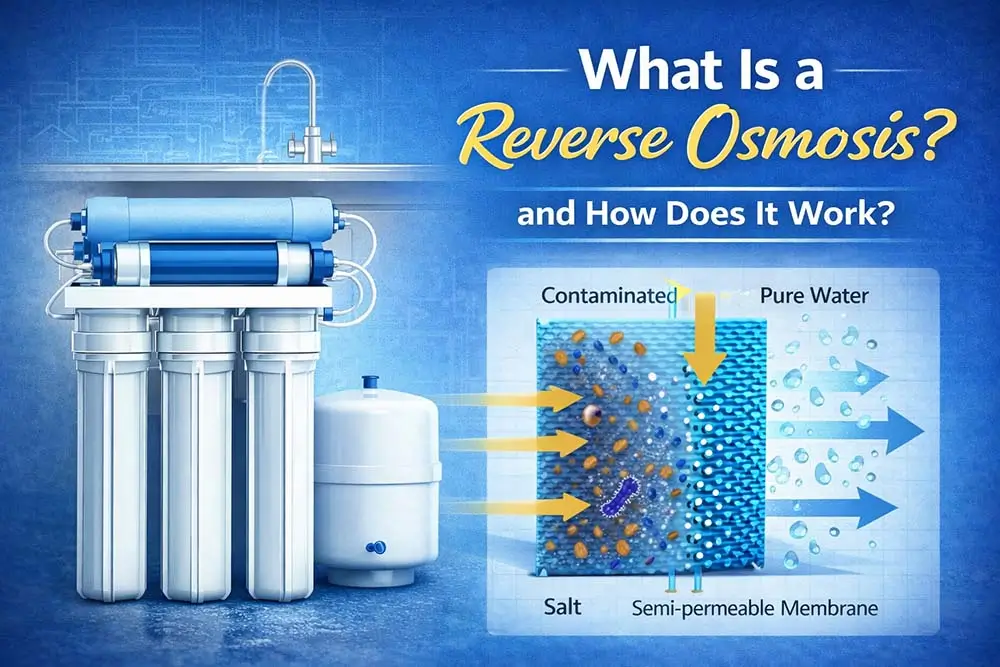
What is Reverse Osmosis? The Ultimate Water Purifying System.
Water is a basic means of survival, and good health depends on the availability of clean and safe water. Where freshwater resources are either scarce or polluted, water purification has been revolutionized by using technologies such as Reverse Osmosis (RO). You may want to install a reverse osmosis water filter in your home, a large scale RO filtration system to use in industries or reverse osmosis desalination to convert seawater to water, but whatever you do, it is important to have the knowledge of how an RO system works and why it is desirable to use.
The guide will discuss the principle of reverse osmosis, its operation, uses, advantages, as well as the most common types of RO systems in UAE.
Have the cleanest water with Reverse Osmosis filtration today.
How the Reverse Osmosis Process Works
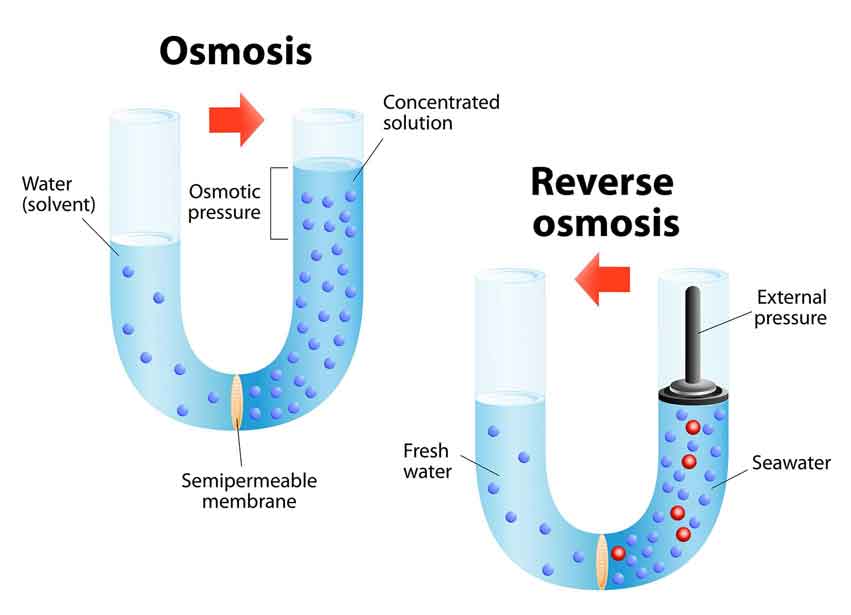
The reverse osmosis process may sound technical, but it’s straightforward once you understand the steps. Here’s how an RO system purifies water:
- Pre-Filtration: Water first passes through a sediment filter to remove large particles like sand, dirt, and rust.
- Carbon Filtration: Next, activated carbon filters remove chlorine, odors, and chemicals that could damage the RO membrane.
- RO Membrane: The heart of the system is the semi-permeable membrane. Under pressure, water passes through this membrane, leaving behind dissolved salts, heavy metals, and other contaminants.
- Post-Filtration / Polishing: Finally, water goes through a post-carbon filter for improved taste and purity.
This step-by-step filtration ensures that up to 99% of impurities are removed, making the water safe and clean to drink.
Understanding Reverse Osmosis: The Key to Clean and Purify Water
Reverse Osmosis is a type of water purification technology which relies on a semi-permeable membrane to absorb dissolved impurities, contaminants, and solids in water. The system presses the water forcing it to go through the membrane, which only lets water molecules through, preventing contaminants like salts, heavy metals, bacteria and viruses.
RO systems can be used to take out 99 percent of the contaminants making them one of the best water purification technologies in the market today. It is used in the production of purified drinking water, desalination of seawater and in the treatment of waste water.
How Does a Reverse Osmosis System operate?
The reverse osmosis process entails filtration stages several times to make sure that the water does not have any contaminants. The following is a description of the operation of RO filtration systems:
Pre-Filtration
Water is first filtered through a pre-filter which removes bigger particles such as sand, dirt and sediment. This is done to make sure that the following filtration processes are not blocked with debris and the system is made more efficient.
Reverse Osmosis Membrane
The high pressure is then applied through a semi-permeable membrane. Such a membrane is meant to eliminate salts, heavy metals, microorganisms, and chemical contaminants. The membrane can only allow the pure water molecules to pass through and leave the contaminants behind.
Post-Filtration
Once water has been filtered through the RO membrane, it is filtered again through a post-filter to eliminate any other contaminants and results in crystal clear and very tasty water.
Storage
The clean water is then stored in a tank where it can be used later on to make sure that when it is required, it is at hand.
Exploring Different Types of Reverse Osmosis Systems for Everyday Need
RO systems have many different types available depending on use, including residential or large scale industrial or seawater desalination. The most widely used types of reverse osmosis systems are:
Under-Sink RO Systems
Perfectly suited to Home Usage.
These systems are installed under the kitchen sink and supply purified water to your faucet. They are small in size and simple to install, thus suit small houses or apartments.
Countertop RO Systems
Portable & Easy to Use.
Countertop RO filters are the best bet when one requires a portable and easy to install water filtration system. They do not need to be installed and can be directly connected to a faucet.
Whole-House RO Systems
Perfectly suited to Larger Homes.
Whole-House RO Systems will filter all the water coming into your home and deliver pure water to all faucets. They can be used in big families or where there is a problem of hard water.
Industrial RO Systems
Commercial Commercial High-Capacity Systems.
RO systems in industries are engineered to address large-scale filtration requirements. They can be applied in factories, restaurants and large businesses where a lot of purified water is needed.
Seawater desalination RO Systems.
For Saltwater Conversion
The seawater is converted into fresh water using Reverse Osmosis desalination. These systems are loaded with high pressure pumps and big membranes that can be used to desalinate seawater to be used as drinking and irrigation water.
Why Reverse Osmosis Systems Matters?
Reverse osmosis water filtration systems are highly regarded in the purification of water due to a number of reasons:
Removal of Harmful Contaminants
RO systems can eliminate a broad spectrum of contaminants (including):
- Chlorine
- Heavy metals (e.g., lead, mercury)
- Pesticides and herbicides
- Bacteria and viruses
- Dissolved salt and other solids.
This renders RO filtration as the most sure-footed option to providing clean and safe drinking water.
Better Taste & Odor
RO systems eliminate chlorine and other contaminants thus greatly enhancing the taste and smell of the drinking water making it fresher and more enjoyable to drink.
Health Benefits
RO filtration removes bacteria, viruses, heavy metals and other harmful chemicals, thus, making your water safe to drink, as well as eliminating harmful chemicals that can cause adverse effects on your health.
Eco-Friendly & Cost-Effective
By investing into a reverse osmosis system, you will no longer need to rely on bottled water, which will save you money in the long term as well as eliminate the majority of plastic waste.
Easy to Maintain
RO systems are simple to service and only need periodical changes of filters. Frequent maintenance can guarantee the efficient functioning of the system, giving you clean water all year long.
Factors Influencing Prices of Reverse Osmosis Filters
In case of the price of a reverse osmosis system, some factors come to play:
Brand & Quality
Such reputable brands as Culligan, Aqua Best, and Pentair have high-quality systems, which may be priced higher.
System Type & Capacity
The cost will be determined by whether you want to purchase a countertop unit, under-sink unit or a whole-house filtration unit. Larger capacity systems tend to be more expensive.
Technology & Features
Newer systems that include upgraded service like the use of UV sterilization, remineralization, and smart sensors are pricier because of additional features.
Installation & Maintenance
There are systems that are professionally installed, thus increasing the initial cost. Also, it should be taken into account the regular change of filters.
Choosing the Right Reverse Osmosis System for You
In choosing RO system, one should consider the following:
- Water quality: What are the contaminants that you require to eliminate?
- Water usage: What is the amount of water you would have to filter in a day?
- Size & capacity: Make sure that the system is in line with your water usage needs.
- Maintenance: Choose systems that can be easily replaced with filters and those that have long service life.
Some of the Myths about Reverse Osmosis Systems
Myth 1: RO system consumes a lot of water.
Fact: Although RO systems do need water to operate, the current systems have become more optimized, where less water is wasted in the filtration process.
Myth 2: Reverse Osmosis separates all the minerals in water.
Fact: Although most RO systems eliminate numerous minerals, certain systems have a remineralization filter to restore valuable minerals to the water.
Conclusion – Why Invest in a Reverse Osmosis System?
The Reverse Osmosis Water Filter is one of the greatest investments you can make either at home or at a business. It guarantees that you and your family get clean and purified water, which has no contaminants that may cause health hazards. With a variety of RO systems available, it’s easier than ever to find a solution that fits your needs.
For more advanced water treatment solutions, Visit water treatment services in UAE and make the best choice for your health and well-being
FAQs
Q1. How often do I need to replace the filters in an RO system?
Generally, filters need to be replaced every 6 to 12 months, depending on the water quality and the system’s usage.
Q2. Does RO water remove essential minerals?
Yes, RO water removes some minerals, but many systems include remineralization filters to reintroduce essential minerals like calcium and magnesium.
Q3. How long does an RO system last?
An RO system can last 5 to 10 years with proper maintenance.
Q4. Can I install an RO system myself?
Countertop RO systems are usually easy to install, but under-sink and whole-house systems may require professional installation.
