
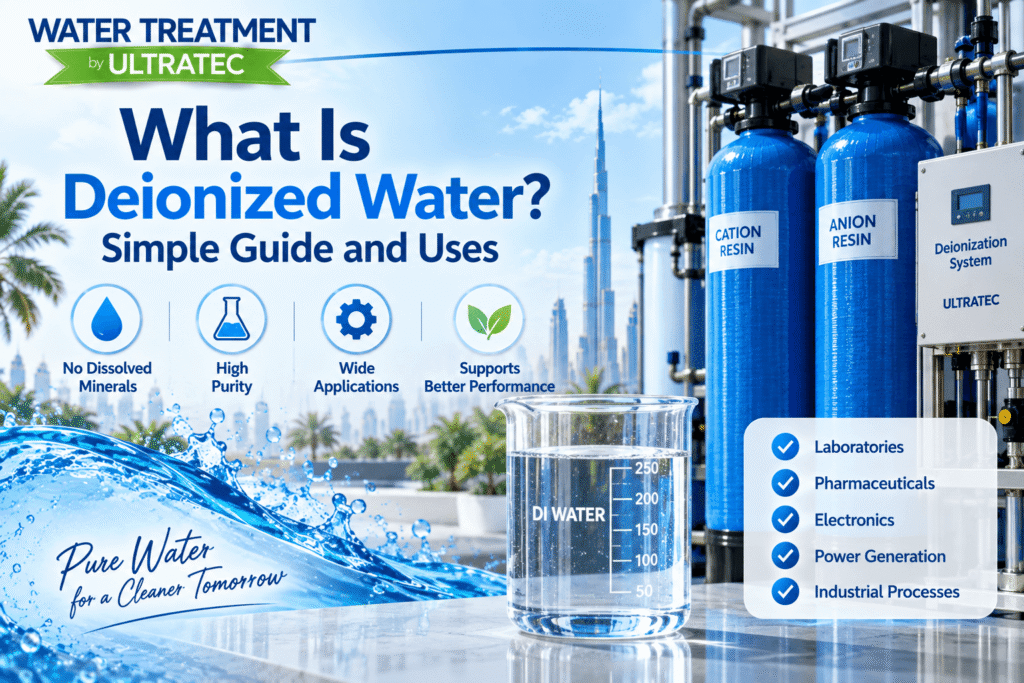
Deionized water is water that has had most of its electrically charged minerals and salts removed. It is also called DI water or demineralized water. Unlike normal filtered water, deionization uses special resin to remove ions such as calcium, magnesium, sodium, chloride, and sulfate. The result is water with very low levels of dissolved ions and electrical conductivity. Companies like Water Treatment UAE offer deionization systems designed for applications where even trace mineral content can affect equipment performance or process accuracy.
But what makes deionized water different from regular purified water? And how does deionized water vs. RO water compare? Let’s keep it simple.
Table of Contents
ToggleWhat Is Deionized Water?
During an ion-exchange process, deionized water removes all the electrically charged particles. Minerals dissolve in regular water as a result of these particles’ presence. Calcium, magnesium, sodium, and chloride are some common examples.
The resin beads inside a DI system attract charged particles and switch them out for hydroxyl and hydrogen ions. Subsequently, these join to create water. The primary purpose is to generate water that contains minimal ionic content for situations in which even minimal mineral presence impacts processes or results.
What Is Removed From Deionized Water?
| Common ions in water | Charge | Examples |
| Cations | Positive | Calcium, magnesium, sodium |
| Anions | Negative | Chloride, sulfate, nitrate |
| Result | — | Much lower ionic content |
How Does Deionized Water Work?
Ion-exchange resin is the core component of a typical DI system. As the water runs by the resin, one resin attracts positively charged ions and the other resin attracts negatively charged ions. Cation resin and anion resin are the two main groups of resins. Positive ions, or cations, are removed by cation resin, and negative ions, or anions, are removed by anion resin.
Some designs use separate resin beds, while other systems utilize a mixed-bed approach by combining both types of resin within a single vessel. These Mixed-bed systems produce water that is extremely high in purity.
Deionized Water Uses
There are many deionized water uses, particularly in industries where minerals and dissolved ions can cause problems.
1. Laboratory Applications
Laboratories use DI water for cleaning, preparing solutions and other processes where minerals in ordinary water could affect test results.
2. Pharmaceutical Industry
High-purity water is used in pharmaceutical and related manufacturing processes where controlled water quality is important.
3. Electronics Manufacturing
DI water is useful in electronics and semiconductor manufacturing because unwanted minerals and ions can interfere with sensitive production processes.
4. Industrial Equipment
Industrial manufacturing processes sometimes include so-called deionized water applications involving mineral deposit reduction after cleaning, rinsing, or cooling.
5. Car and Glass Cleaning
DI water is also useful for cleaning cars, windows, and other surfaces because water with very low mineral content can dry with fewer spots and residues.
6. Dehumidifiers
Some humidifiers and comparable equipment perform better when they use low-mineral water because this decreases the formation of deposits inside the device.
Deionized Water vs RO Water
One of the most common questions is the difference between deionized and RO water. Both methods improve water quality, but they work in different ways.
- Reverse osmosis (RO) uses a semi-permeable membrane to reduce dissolved solids, salts and many other contaminants.
- Deionization uses ion-exchange resin specifically to remove electrically charged ions.
RO is often used as a treatment step before DI because it can reduce much of the dissolved load entering the DI system. This can help DI resin last longer.
Deionized Water vs RO Water: Quick Comparison
| Feature | Deionized Water | RO Water |
| Main process | Ion exchange | Membrane filtration |
| Main target | Dissolved ions | Dissolved solids and many contaminants |
| Mineral removal | Very high for ions | High, depending on system |
| Bacteria/viruses | Not the main target | Reduction depends on system and membrane |
| Typical use | Industrial and high-purity applications | Drinking and general water treatment |
| Can be combined? | Yes | Yes |
The two technologies are not necessarily competitors. In many industrial systems, RO and DI are used together. RO handles much of the dissolved load first, followed by DI polishing to achieve a higher level of purity.
Is Deionized Water Safe to Drink?
This question makes more sense with a bit of background information. Although deionized water contains very few minerals, the deionization process does not remove all types of contaminants. Additional processing is required to eliminate uncharged compounds and microorganisms that the system alone cannot remove. DI water is only created to serve specific laboratory, industrial, and technical functions instead of being selected to supply regular drinking water to consumers. The manufacturing of DI water targets precise technical requirements.
A treatment system designed to provide potable water should address the specific needs of potable water treatment if the system is going to produce drinking water.
Why Is DI Water Used After RO?
RO and DI can work well together because each process performs a different job.
RO removes a large portion of dissolved solids before the water reaches the DI stage. The DI resin can then remove remaining ions and further reduce conductivity. This arrangement can extend the operating life of DI resin and reduce the amount of regeneration required.
| Treatment Stage | Main Purpose | Typical Result |
| Pretreatment | Protect equipment | Removes larger particles and reduces specific feed problems |
| RO | Reduce dissolved solids | Lower TDS and contaminant load |
| DI | Remove remaining ions | Very low ionic content |
| Final treatment | Application-specific | Water prepared for its intended use |
The exact setup depends on the incoming water quality and the purity required by the application.
What Is the Difference Between DI Water and Distilled Water?
DI water and distilled water are sometimes treated as the same thing, but they are produced differently.
Distillation uses heat to turn water into vapor and then condenses it back into liquid. Deionization uses ion-exchange resin to remove charged particles.
| Water Type | Main Treatment Method | Common Uses |
| RO Water | Semi-permeable membrane | Drinking, industrial treatment |
| DI Water | Ion exchange | Labs, electronics, industrial processes |
| Distilled Water | Evaporation and condensation | Technical and specific household uses |
The right option depends on the quality of water required, not simply which process sounds more advanced.
How Do You Know If You Need Deionized Water?
DI water is usually necessary when remaining total ion levels in standard treated water solutions interfere with chemical or laboratory processes. Certain industrial applications, electronics production, laboratories and pharmaceutical manufacturing and pharmaceutical manufacturing need lower conductivity than drinking water systems provide. The actual need can be established through water-quality testing. Water passes fewer electrical currents as ionic content declines, and conductivity serves as a standard measure of ionic content.
Final Thoughts
So, what is deionized water? Simply put, it is water treated through ion exchange to remove dissolved ions such as calcium, magnesium, sodium, and chloride.
Its value is not that it is automatically “better” than every other type of treated water. Its value comes from producing water with very low ionic content for applications where minerals can interfere with a process.
RO and DI also do not have to be used separately. Many treatment systems use RO first and DI afterward to produce higher-purity water.
For drinking water, industrial treatment, laboratories, or manufacturing, the right technology should always be selected according to the required water quality and application.
Frequently Asked Questions
What is deionized water?
Deionized water is water treated with ion-exchange resin to remove most dissolved electrically charged minerals and salts.
What are the main deionized water uses?
Common uses include laboratories, pharmaceutical production, electronics manufacturing, industrial processes, equipment cleaning, and spot-free surface cleaning.
Is deionized water the same as RO water?
No. RO uses a membrane to reduce dissolved solids and many contaminants, while DI uses ion exchange to remove dissolved ions.
What is the difference between deionized and RO water?
The main difference is the treatment method and target. RO reduces a broad range of dissolved substances, while DI specifically removes charged ions.
Is deionized water safe for drinking?
DI water is not normally selected as everyday drinking water because deionization does not remove every type of contaminant. Drinking-water treatment should be designed for potable use.
