
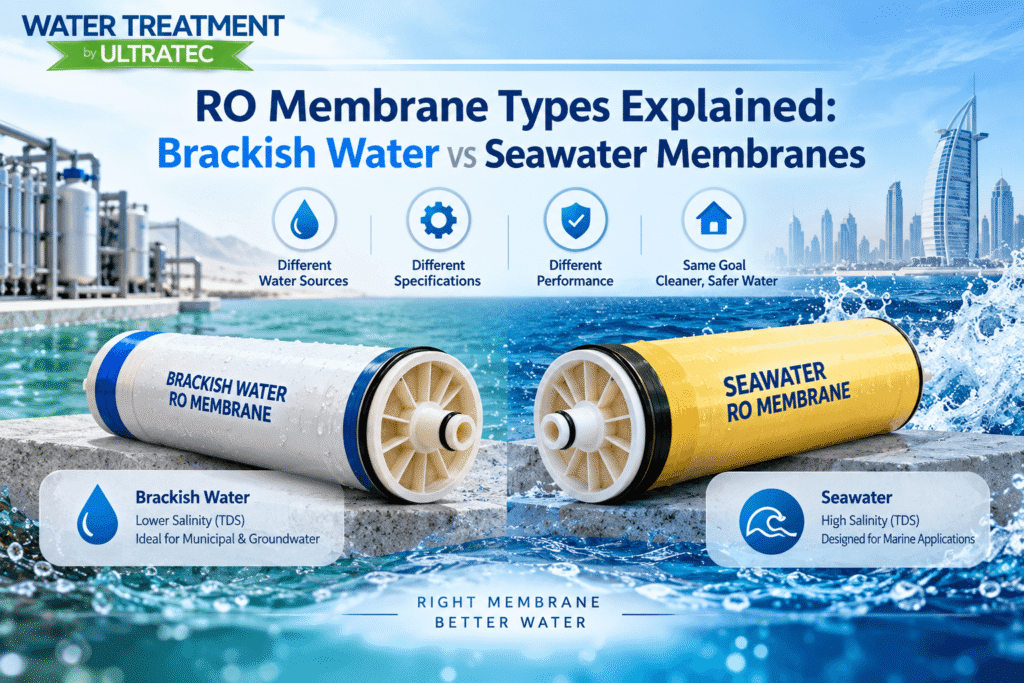
The process of reverse osmosis provides a common method for eliminating dissolved salts together with other unwanted compounds from water. Not all RO membranes function the same for every feedwater type. Only some RO membranes suit specific feedwater types. Selecting a membrane based on fit with an RO vessel can cause inadequate system output, wasteful power utilization, and shortened membrane life. All feedwater salinity, operating pressure, required flow recovery, and treatment goals should influence membrane selection.
The two most significant RO membrane categories include brackish water membranes and seawater membranes. For sure, they have a similar exterior appearance, but they need different operating procedures. The process of choosing appropriate membranes becomes more straightforward if one understands their differences. This guide from Water Treatment breaks both categories down so you can match the right membrane to your feedwater.
Table of Contents
ToggleWhat Is an RO Membrane?
The RO membrane is a semi-permeable membrane that operates in reverse osmosis systems to partition tap water from salts that are dissolved and other impurities. The membrane receives feed water under pressure. Water molecules that permeate the membrane pass through it while dissolved salts remain in the concentrate stream, along with a majority of the rejected substances.
The membrane functions as an aggregate unit. Footages performance in total of an RO plant depends on pumps and pressure vessels, pretreatment, and flow controls, together with different elements. The membrane exists mainly as a thin-film composite, and it comes in several sizes and configurations designed for residential, commercial, and industrial use.
What Are the Main Types of RO Membranes?
Many ways exist to classify RO membranes, but the most suitable method is to differentiate based on feed-water characteristics. Categories normally include:
- Brackish water reverse osmosis membranes
- RO membranes for seawater
- Residential or low-pressure R.O. membranes
- Specialized membranes made to perform specific industrial tasks
The two most frequently compared categories in bigger water treatment systems consist of brackish water membranes and seawater membranes.
What Is a Brackish Water RO Membrane?
Brackish water RO membranes accept feed water that has a salt concentration level lower than seawater does. Brackish water is obtained from wells, surface water sources, groundwater, and other water supplies with raised levels of soluble salts. Different locations show substantial differences in water chemistry. RO systems using brackish water as their feed can run at decreased pressures due to their lower osmotic pressure versus seawater.
Brackish water membranes are commonly used for:
- Groundwater treatment
- Drinking-water production
- Commercial RO plants
- Industrial process water
- Municipal water treatment
- Water reuse applications
A brackish membrane should not be selected solely based on the word “brackish.” A proper water analysis is still important because TDS is only one part of membrane selection.
What Is a Seawater RO Membrane?
The seawater RO membrane is designed to withstand much higher salinity and osmotic pressure than the common brackish-water membrane. Because seawater contains a lot of dissolved salts, it takes a lot more pressure to push water through the membrane to obtain permeate.
Seawater membranes are designed to operate at high pressures and are widely used in desalination plants. Common applications include:
- Desalination of seawater
- Water Treatment for Marine Applications
- Treatment of high salinity water
- Large Desalination Facilities
- Desalination, industrial
- Seawater Desalination for Potable Water
The osmotic pressure of the feed water for a seawater membrane may be higher than that for a brackish-water membrane, and hence the operating pressure may be higher.
Brackish Water Membrane vs Seawater Membrane
The easiest way to understand the difference is to look at the conditions each membrane is designed to handle.
| Factor | Brackish Water RO Membrane | Seawater RO Membrane |
| Feed water | Brackish / moderately saline | Seawater / high salinity |
| Typical pressure | Lower than SWRO | Higher |
| Osmotic pressure | Lower | Much higher |
| Energy requirement | Generally lower | Generally higher |
| Main application | Groundwater, industrial and commercial RO | Desalination and high-salinity treatment |
| System design | BWRO | SWRO |
| Membrane selection | Based on feed quality and required output | Based on high-salinity feed and desalination requirements |
The exact operating conditions can vary significantly between membrane models, so these categories should be treated as general guidelines rather than fixed numbers.
Why Can’t You Use Any RO Membrane for Seawater?
A common mistake is assuming that an RO membrane is an RO membrane regardless of the application. Seawater creates substantially higher osmotic pressure than brackish water. A membrane and system designed for lower-salinity feed may not provide the required performance when exposed to seawater conditions. Seawater RO systems also require suitable high-pressure equipment and carefully designed pretreatment.
Using the wrong membrane can affect:
- Permeate production
- Salt rejection
- Energy consumption
- Recovery
- Membrane service life
- Overall system reliability
For this reason, membrane selection should begin with a water analysis and system design rather than membrane size alone.
How Does a Seawater RO Membrane Work?
The basic principle is similar to other RO membranes. Feed water is pressurized and forced over the surface of the membrane. It allows water to pass through but blocks a large percentage of dissolved salts. The purified stream is called permeate, and the concentrated stream is called concentrate or reject. The only difference is in the location of the membrane. The seawater requires more pressure because the salt concentration makes the water more resistant to flowing through the membrane.
Thus, a seawater RO plant needs a properly sized high-pressure pump, appropriate membrane vessels, and controls designed for the operating pressure.
Which RO Membrane Is Right for Your System?
There is no universal “best” RO membrane. The correct membrane depends on the feed-water conditions and the treatment objective. Before selecting a membrane, consider:
Feed-Water TDS
TDS provides an initial indication of dissolved solids, but it should not be the only parameter considered.
Water Temperature
Temperature affects membrane permeate flow. Colder water generally produces less permeate than warmer water under otherwise similar conditions.
Required Flow
The membrane needs to provide the required permeate production without operating outside its recommended conditions.
Salt Rejection
If high-quality permeate is required, the membrane’s salt-rejection performance is an important consideration.
Recovery
System recovery determines how much feed water becomes permeate. Higher recovery can increase concentration and scaling risks if the system is not properly designed.
Fouling and Scaling Potential
Silica, hardness, suspended solids, organics, and biological growth can affect membrane performance. Pretreatment should be designed around the actual feed-water analysis.
Can you use a brackish water membrane for seawater?
In a seawater desalination system, it is uncommon to substitute a brackish water membrane with a seawater membrane. The membrane must be qualified for the feedwater salinity and the operating pressure required by the application.
Likewise, the use of a high-pressure seawater membrane for a lower salinity application may not always be the most practical choice. The membrane should be selected for the actual operating conditions, not assuming that a higher pressure rating is automatically better.
How to Extend RO Membrane Life
Correct membrane selection is only the beginning. Proper pretreatment is one of the most important factors in protecting an RO membrane. Depending on the feed water, treatment may include sediment filtration, multimedia filtration, activated carbon, cartridge filtration, antiscalant dosing, or other processes.
Regular monitoring is also important. Operators should keep track of feed pressure, permeate flow, concentrate flow, conductivity, pressure drop, and other relevant parameters. A noticeable change in normalized performance can indicate fouling, scaling, or another operating problem. Cleaning should also be carried out when required and according to the membrane manufacturer’s recommendations.
Final Thoughts
Understanding the different types of RO membranes is important before selecting an element for any water-treatment system. Brackish-water membranes are designed for lower-salinity feed water and generally operate at lower pressures. Seawater membranes are designed for much higher salinity and require higher-pressure operation.
The difference is not simply a matter of choosing one membrane over another. The entire RO system has to match the feed-water conditions. If you are comparing a brackish water membrane vs. a seawater membrane, start with the water analysis, required production, recovery, operating pressure, and treatment objective. Then select a membrane whose technical specifications match those conditions. That approach gives you a better basis for reliable RO performance than choosing a membrane based only on size, brand, or price.
Frequently Asked Questions
What are the main types of RO membranes?
Common categories include brackish water RO membranes, seawater RO membranes and lower-pressure membranes used in residential and commercial systems. Specialized industrial membranes are also available.
What is the difference between brackish water and seawater RO membranes?
Brackish-water membranes are designed for lower-salinity feed water, while seawater membranes are designed for much higher salinity and higher operating pressure.
What is a seawater RO membrane used for?
Seawater RO membranes are primarily used for desalination and treatment of high-salinity water, including municipal, industrial, and marine applications.
Can a seawater RO membrane treat brackish water?
A seawater membrane may be capable of operating with lower-salinity water, but it should not automatically be considered the correct choice. The membrane and system should be selected according to actual feed-water conditions.
