
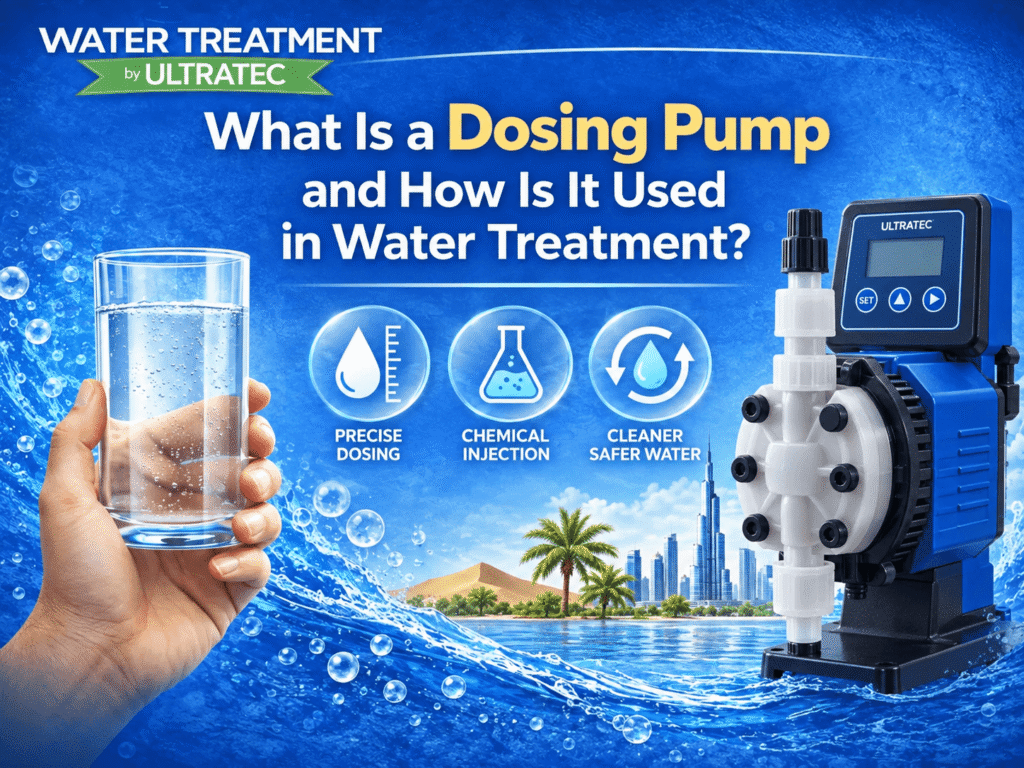
A dosing pump is a type of pump used to add a controlled amount of liquid chemical into a water or process stream. Instead of moving large quantities of water like a conventional transfer pump, it is designed to deliver a measured dose at a controlled rate.
In water treatment, accurate chemical dosing is important because adding too little chemical may reduce treatment performance, while excessive dosing can waste chemicals and increase operating costs. This is why dosing pumps are commonly found in drinking water plants, wastewater treatment systems, RO plants, industrial water-treatment equipment and other chemical treatment applications.
Table of Contents
ToggleWhat Is a Dosing Pump?
A dosing pump, metering pump, or chemical dosing pump is a pump used for injecting a precise volume of chemical into a flow of liquid. Usually, the chemical is stored in a separate tank. The dosing pump draws the chemical from the tank and pumps it into the water line at the rate required. Depending on the design of the pump, the dosing rate can be controlled by varying the stroke length, stroke frequency, flow setting, or other control parameters. The goal is straightforward: to deliver the right chemical at the right rate and at the right moment in the treatment process.
Dosing systems typically use chemicals such as chlorine, antiscalants, coagulants, acids, alkalis, and other water-treatment chemicals.
How Does a Dosing Pump Work?
The exact principle of operation will depend on the type of dosing pump, but generally most systems work in the same way. The chemical is first stored in a dosing tank. The pump pulls the chemical through a suction line and pushes it into the pump chamber. The pump then measures or controls the chemical volume and forces it through a discharge line into the water stream.
In a positive-displacement dosing pump, the volume of the pump chamber is continuously changed by the pumping movement. At one point in the cycle, chemical flows into the chamber. Then in the next part, the chemical gets pushed out toward the injection point. This movement is commonly caused by a diaphragm or piston .
Main Parts of a Chemical Dosing Pump System
A complete dosing setup normally includes more than the pump itself.
Chemical Tank
The tank stores the chemical solution before it is injected into the treatment system. Tank size depends on chemical consumption, concentration, and how frequently the system needs refilling.
Dosing Pump
This is the main component responsible for moving and controlling the chemical.
Suction Line
The suction line connects the chemical tank to the pump and allows the pump to draw in the chemical solution.
Injection Line
The discharge or injection line carries the chemical from the pump to the treatment pipeline.
Injection Point
The chemical needs to enter the water at a suitable location. Proper injection-point selection helps the chemical mix effectively with the water.
Valves and Accessories
Depending on the system, accessories may include foot valves, pressure-relief valves, calibration columns, pulsation dampeners, back-pressure valves, and injection assemblies. The exact configuration depends on the chemical, pressure, flow rate, and treatment process.
What Are the Main Uses of Dosing Pumps?
Dosing pumps have many applications in water and wastewater treatment.
Chlorine Dosing
Chlorine can be dosed into water for disinfection. A dosing pump allows the chemical feed to be controlled according to the treatment requirement.
Chlorination systems are used in drinking-water treatment and other applications where controlled chemical disinfection is required. Water-powered dosing technology is also used for proportional chlorine injection in water networks.
Antiscalant Dosing in RO Plants
Reverse osmosis membranes can be affected by scale-forming compounds in feed water. Antiscalant dosing is therefore commonly used as part of RO pretreatment. A dosing pump feeds the required amount of antiscalant into the feedwater before it reaches the RO membranes. The dosing rate needs to be selected according to the water chemistry, system flow, and chemical manufacturer’s recommendations.
pH Adjustment
Acid or alkaline chemicals can be added to adjust water pH. A dosing pump provides controlled chemical addition so that the treatment process can maintain the required pH range.
Coagulant Dosing
In some water and wastewater treatment processes, coagulants are added to help destabilize suspended particles so they can be separated more effectively. Accurate dosing is important because the required chemical quantity can change according to water quality and process conditions.
Wastewater Treatment
Chemical dosing is also used in wastewater treatment for processes such as pH correction, disinfection, and other chemical treatment stages. The pump allows operators to control chemical feed instead of manually adding chemicals to the treatment tank.
What Is the Function of a Dosing Pump?
The primary dosing pump function is controlled chemical injection.
However, its role in a water-treatment system can be broken down into several functions:
- Draw chemical from a storage tank
- Measure or control chemical feed
- Inject chemical into the water stream
- Maintain a selected dosing rate
- Support consistent treatment performance
- Reduce unnecessary chemical consumption
- Allow chemical feed to be adjusted according to process conditions
In automated treatment plants, dosing pumps can also be connected to controllers, flow meters, pH sensors, chlorine analyzers, or other instruments.
Types of Dosing Pumps
Different applications require different pump designs.
Diaphragm Dosing Pumps
Diaphragm pumps have a flexible diaphragm that moves the chemical. They are very commonly used for dosing chemicals because the diaphragm separates the pumping mechanism from the chemical being handled.
The diaphragm moves back and forth, changing the volume in the pump chamber, creating the suction and discharge action.
Piston Dosing Pumps
Piston Dosing Pumps operate by moving a measured volume of liquid using a reciprocating piston. These pumps can be ideal for applications requiring controlled dosing at higher pressures, but it is important to select the right pump based on the chemical and operating environment.
Electromagnetic Dosing Pumps
There is an electromagnetic mechanism that powers the diaphragm to operate these pumps. When precision and adjustable chemical dosing are needed in smaller feed applications, these pumps are extensively utilized.
Motor-Driven Dosing Pumps
Motor-driven metering pumps use an electric motor to operate the pumping mechanism. They are available in different capacities and configurations for industrial and commercial treatment systems.
Water-Powered Dosing Pumps
Some dosing pumps use the water line itself as the energy source. In these systems, water pressure and flow operate the internal mechanism, allowing chemicals to be injected proportionally to the water flow.
This type can be useful in applications where electrical power is unavailable or where proportional dosing is required.
Why Accurate Dosing Matters in Water Treatment
Chemical dosing isn’t just adding a chemical to water. What matters is the amount. An RO plant not dosed with sufficient antiscalant may not be adequately protected against scaling. But over-dosing with chemicals may lead to increased chemical consumption without any corresponding benefit. The same principle applies to chlorine, pH control chemicals, and other chemicals for treatment. A correctly chosen dosing pump makes it easier to control the treatment process and helps to keep the chemical feed consistent.
How to Select a Dosing Pump
Choosing a dosing pump should start with the application rather than the pump price.
Consider these factors before selecting a model:
1. Chemical Type
Different chemicals have different properties. Chemical compatibility should be checked for the pump head, diaphragm, seals, tubing, and other wetted components.
2. Required Dosing Rate
Determine how much chemical needs to be injected, normally expressed as a flow rate such as litres per hour.
3. Operating Pressure
The pump must be capable of delivering the chemical against the pressure at the injection point.
4. Chemical Concentration
The concentration of the chemical solution affects the required dosing rate and storage requirements.
5. Water Flow
For proportional dosing applications, the water flow rate is an important part of the calculation.
6. Control Method
Some systems require manual adjustment, while others may need automatic control through flow meters, pH sensors, chlorine analyzers, or a PLC.
7. Installation and Maintenance
The pump should be practical to install, calibrate, and maintain. Availability of replacement diaphragms, valves, and other spare parts should also be considered.
Dosing Pump vs Regular Water Pump
A dosing pump is not the same as a conventional water pump. Generally, regular water pumps are used to move water from one location to another at a required flow and pressure. A dosing pump is chosen when a specific amount of chemical must be inserted into another fluid. For example, a feed pump can pump water through a RO plant, or a chemical dosing pump can inject antiscalant into the water before it passes through the membranes. The pumps can be in the same treatment system, but their jobs are different.
Final Thoughts
Dosing pumps are small but important components of many water treatment systems. Their job is to supply chemicals in a controlled, repeatable way so that the treatment process can do what it is supposed to do. Chlorine dosing, antiscalant dosing, pH control, wastewater treatment. The correct dosing system depends on the chemical, flow, pressure, concentration, and level of control required. Understanding how a dosing pump works will help you select the right equipment for a given water treatment application. When choosing a pump based on capacity or price alone, consider the total requirement for dosing.
Frequently Asked Questions
What is a dosing pump?
A dosing pump is a controlled metering pump used to inject a specific quantity of liquid chemical into a water or process stream.
How does a dosing pump work?
The pump draws chemical from a storage tank and delivers it through an injection line at a controlled rate. Diaphragm and piston pumps use reciprocating movement to create suction and discharge.
What are dosing pumps used for?
Common dosing pump uses include chlorine dosing, antiscalant injection, pH adjustment, coagulant dosing, and chemical treatment in wastewater and industrial water-treatment systems.
What is the function of a dosing pump in an RO plant?
In an RO plant, a dosing pump can inject antiscalant or other treatment chemicals into the feedwater. The exact chemical and dosing rate depend on the feedwater chemistry and plant design.
What is a chemical dosing pump?
A chemical dosing pump is a metering pump specifically selected to handle and inject treatment chemicals at a controlled rate.
Do dosing pumps need electricity?
Not all dosing pumps require electricity. Many conventional metering pumps are electrically driven, while some proportional dosing pumps use water pressure and flow as their power source.
How often does a dosing pump need maintenance?
Maintenance depends on the pump type, chemical being handled, operating conditions and manufacturer’s recommendations. Regular inspection of diaphragms, valves, seals, tubing and injection components can help identify problems before they affect dosing accuracy.
