
Table of Contents
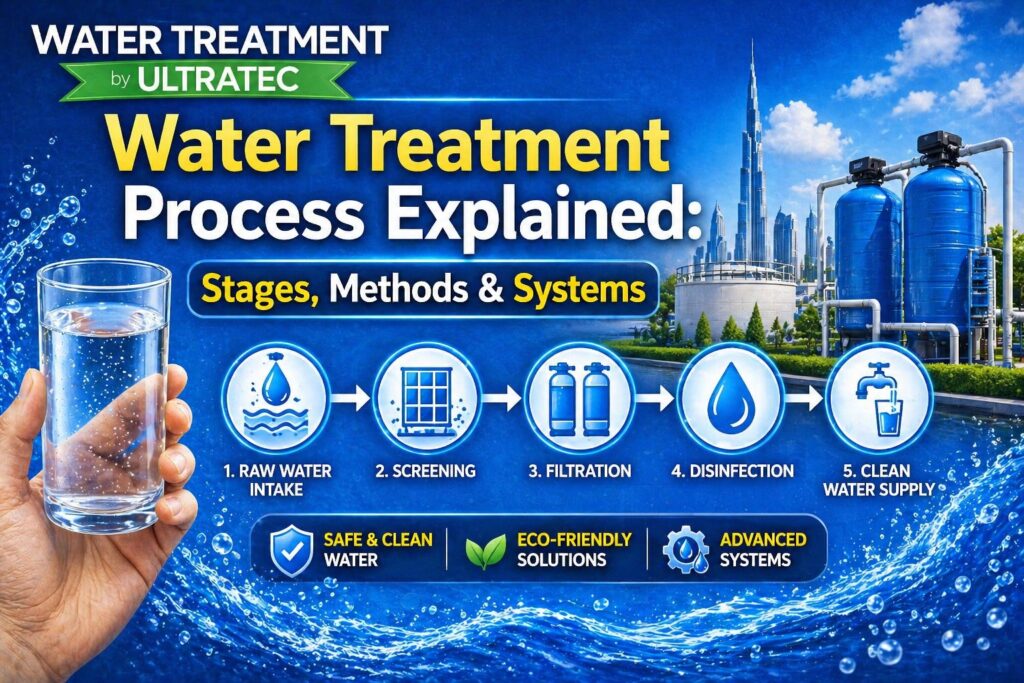
ToggleWater Treatment Process Explained: Stages, Methods & Systems
Safe drinking water involves a vital control step which guarantees both human drinking, industrial applications and ecological protection. Multiple design stages function to eliminate contaminants alongside pathogens and unwanted minerals while producing safe drinking water.
This detailed instruction will teach you about both the fundamental water treatment systems procedures as well as the different treatment methods together with the systems which operate them.
Understanding the Water Treatment Process
Essentially water treatment makes up the core element of contemporary infrastructure. Untreated raw water from natural sources such as underground aquifers or lakes or rivers undergoes the treatment process to become potable and clean water. The process plays an essential role in securing drinking water safety alongside public health preservation and agricultural and industrial water supply.
What Are the Steps in the Water Treatment Process?
The entire water treatment process consists of various necessary steps that function to eliminate certain categories of pollutants. Let’s analyze them individually:
Coagulation and Flocculation
Coagulation: The water treatment process begins with the first step called coagulation. The chemical treatment here enables diverse particles such as organic matter, clay and dirt particles to bind together. Chemical coagulants produce flocs which are the formation of clumps that can be removed subsequently.
Flocculation: Once coagulation is completed the water is gently stirred to produce bigger flocs that enables particles to settle. The aggregated smaller particles were unable to settle during the coagulation stage will be eliminated at this stage.
Sedimentation
Flocculation precedes storage in a sedimentation tank where heavier flocs sink to the tank’s bottom. The collected clear water which forms on top will proceed for additional treatment.
Filtration
Water passes through filters constructed from diverse materials including the use of activated charcoal, gravel and sand in this phase. The process of filtration eliminates both smaller particles along with dissolved contaminants missed by the previous treatment stages.
- Activated Carbon Filtration: Activated carbon filters which represent one of the standard filtration methods remove chlorine and VOCs as well as various other contaminants.
- Chlorination: the process involves adding pure chlorine to water so that remaining bacteria, viruses, or other pathogens which maybe make people sick can get eradicated. Municipal water treatment systems commonly use chlorine as a primary disinfection method for treating water supplies. Disinfection
- UV Disinfection: Chlorine may be supplemented by using ultraviolet (UV) light for water disinfection. UV systems serve as prominent choices for water treatment as they eliminate pathogens effectively without implementing chemical processes.
Storage and Distribution
Once treated, the water is stored in reservoirs or tanks before being distributed to homes, businesses, and industries. During this stage, water is stored in clean and secure environments to ensure it remains uncontaminated before it reaches the final consumer.
| Stage | Description | Contaminants Removed |
|---|---|---|
| Disinfection | Water is disinfected using chlorine, UV light, or ozone to kill pathogens | Pathogenic bacteria, viruses, parasites, and microorganisms |
| pH Adjustment | The pH of the water is adjusted using chemicals like lime to ensure the water is neither too acidic nor too alkaline. | pH-related impurities, which may include excess acidity or alkalinity |
| Storage & Distribution | After treatment, water is stored in tanks and distributed via pipelines to households and businesses. | No contaminants if all previous stages are completed efficiently |
| Stage | Description | Contaminants Removed |
|---|---|---|
| Screening | Large debris such as leaves and sticks are removed through mesh screens. | Large solids and debris |
| Coagulation/Flocculation | Coagulants like alum are added to the water, causing small particles to clump together into larger flocs. | Small suspended particles, dirt, bacteria, viruses |
| Sedimentation | Water is allowed to sit in tanks, causing the flocs to settle at the bottom by gravity. | Larger particles and flocs |
| Filtration | Water passes through filters (sand, activated carbon) to remove smaller particles. | Suspended solids, fine particles, organic compounds, chlorine, and some contaminants |
How Does a Water Treatment System Work?
A water treatment system is a series of processes that remove contaminants from water to render it safe for consumption or other uses. This is done through a combination of physical, chemical and biological processes:
- Physical Processes: These involve the removal of suspended solids by coagulation, sedimentation and filtration. These involve the removal of large particles and water clarification.
- Chemical Processes: Coagulation and disinfection are important chemical processes. Alum is used as a coagulant to aggregate contaminants, and chlorine or ozone is used to disinfect the water.
- Biological Processes: Some water treatment facilities use biological filters or biofilm reactors to remove organic contaminants. These treatments use microorganisms to break down organics and improve the water quality.
- Membrane Filtration: Advanced water treatment systems may use reverse osmosis (RO) membranes to remove dissolved solids, salts and other contaminants from the water. These are effective for desalination and removing dissolved minerals.
Types of Water Treatment Methods
The water treatment method is selected based on the source of water, type of contaminants, and the end-use of the water. Here are some of the most common water treatment methods:
Reverse Osmosis (RO)
RO is a powerful water treatment process that involves filtering water through a membrane. It can eliminate 99% of pollutants, including salt, heavy metals and chemicals. RO is most commonly used in regions with hard water or saltwater.
Key Benefits:
- Removes a wide range of contaminants
- Generates pure water
- Can be used for desalination
UV Disinfection
This method involves using ultraviolet light to destroy or inactivate microorganisms. It is safe for the environment (no chemicals) and kills bacteria, viruses and parasites.
Key Benefits:
- No chemical residues
- Broad spectrum pathogen control
- Environmentally friendly
Activated Carbon Filtration
Activated carbon is widely used for the removal of chlorine, volatile organic compounds (VOCs), pesticides and other organic pollutants from water. It does this by capturing the contaminants on the surface of the carbon.
Key Benefits:
- Takes out bad taste and odors
- Removes chlorine and organic chemicals
- Easy and economical filtration
Sand Filtration
Sand filtration is a physical filtration process that removes particles. Water is filtered through a sand bed which captures particles as water passes through.
Key Benefits:
- Low cost
- Easy to maintain
- Good pre-treatment for other filtration systems
Ion Exchange
Ion exchange is used in water softeners to remove calcium and magnesium ions (causing water hardness) and replace them with sodium ions. This helps avoid scale deposits in plumbing and appliances.
Key Benefits:
- Reduces water hardness
- Prevents scale buildup
- Improves appliance lifespan
| Treatment Method | Contaminants Removed | Application | Cost |
|---|---|---|---|
| Reverse Osmosis (RO) | Heavy metals, salts, chlorine | Drinking water, desalination | High |
| UV Disinfection | Bacteria, viruses, pathogens | Drinking water, wastewater | Moderate |
| Activated Carbon | Chlorine, VOCs, organic chemicals | Drinking water, taste improvement | Low |
| Sand Filtration | Suspended solids, debris | Pre-treatment in industrial systems | Low |
| Ion Exchange | Hardness (calcium, magnesium) | Water softening | Moderate |
The Role of Density in Water Treatment
The density of water is an important factor in water treatment. Water with greater density contains more dissolved solids, affecting the filtration process. For example:
- Sea vs. Freshwater: Sea water is denser because of the salt. This makes it harder to filter, and so desalination is more energy intensive in comparison to freshwater.
- Wastewater: Density influences sedimentation and filtration of the wastewater. Denser particles will sink faster in sedimentation tanks, so more waste will be removed.
Statistics
- Around 2 billion people globally do not have access to safely managed drinking water (WHO).
- Reverse Osmosis (RO) systems are capable of removing 99% of contaminants in water, making them one of the most efficient filtration systems.
- Ultraviolet (UV) disinfection systems are 99.99% effective in killing waterborne pathogens.
Factors to Consider in Selecting a Water Treatment System
When choosing a water treatment system, it’s important to consider water quality, usage and cost. Key factors to consider include:
- Water Source: Is your water from a municipal source, well water, or seawater?
- Contaminants: What contaminants are present and need to be removed (e.g., chlorine, bacteria, metals)?
- Flow Rate: What volume of water do you need to purify each day?
- Maintenance: What will the ongoing maintenance and filter replacement costs be?
- Environmental Sustainability: What is the ecological footprint of the system in terms of energy consumption and waste?
Why is the Water Treatment Process Important?
Water treatment is crucial to the health of a community. Here are some reasons why water treatment is essential:
Prevents Waterborne Diseases:
Untreated or improperly treated water may carry disease-causing microorganisms like cholera, typhoid and dysentery. Water treatment eliminates pathogens, helping to prevent diseases.
Improves Water Quality:
Access to safe water enhances quality of life, ensuring safe water for drinking, cooking and personal hygiene.
Protects the Environment:
Water treatment minimizes contaminants in waste water, keeping rivers, streams, lakes and oceans clean.
Industrial and Agricultural Use:
Water treatment is essential for industrial applications, helping ensure water used for manufacturing is of high quality and does not interfere with the end product’s quality. It can also be used in irrigation.
Conclusion: Improve Your Water Treatment
Water treatment is vital for providing safe, clean water and protecting your plumbing. And by knowing the main steps, techniques and systems involved in water treatment, you can ensure that your household or business has access to safe water. Whether it’s reverse osmosis, activated carbon filtration or UV disinfection, each type of water treatment has its advantages and is suitable for different water quality problems.
For more information on water treatment systems, advanced solutions, and sustainable practices, visit Waste Water Treatment Company in UAE. Explore a wide range of water treatment options tailored to your needs.
FAQs:
Q1: What is the best water filter system for a whole house?
The best water filter system for a whole house depends on the water source and the contaminants present. Popular options include reverse osmosis (RO) systems, activated carbon filters, and UV systems.
Q2: What are the types of water filtration systems?
Answer:The common types of water filtration systems are reverse osmosis (RO), activated carbon filtration, UV disinfection, and water softeners.
Q3: What contaminants can reverse osmosis remove?
Answer: Reverse osmosis can remove dissolved solids, salts, heavy metals, bacteria, and other contaminants from water.
Q4: How often should I replace the filters in my water treatment system?
Answer: Filter replacement frequency depends on the type of system and water usage. Typically, reverse osmosis filters should be replaced every 6-12 months, while carbon filters last around 3-6 months.
