
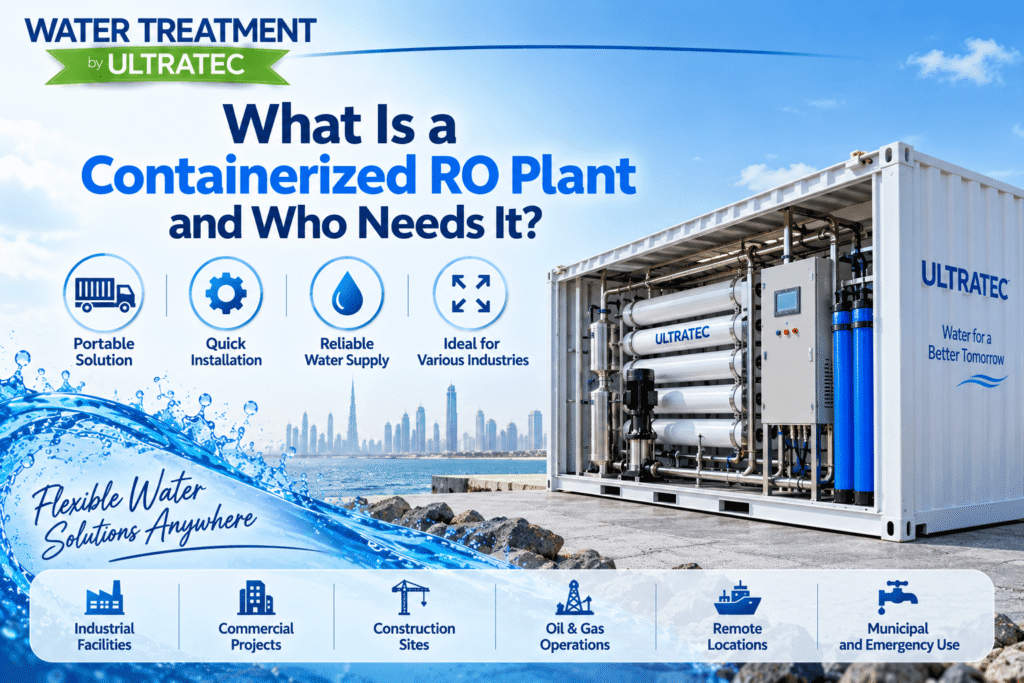
A containerized RO plant is a complete reverse osmosis water treatment system installed inside a shipping container. Instead of building the treatment equipment separately at a fixed site, the main components are assembled inside a protected, transportable unit.
Providers like Water Treatment UAE design these units to be pre-engineered and ready to deploy, which helps reduce on-site construction time and makes the system easier to relocate when project requirements change.
Table of Contents
ToggleWhat Is a Containerized RO Plant?
The containerized reverse osmosis plant is a production-ready water treatment solution that occupies one container. This container works as a tube to store essential elements of the water purification process, including pretreatment filters, chemical dosing equipment, high-pressure pumps, RO membranes, electrical controls, and treatment elements. The equipment installed varies according to which raw water source is used, along with the quality aims for the outlet stream. A desalination containerized unit tailor-made to handle seawater differs in its configuration from systems that process brackish water.
| Component | Main Purpose |
| Pretreatment filters | Remove suspended particles and protect RO membranes |
| Chemical dosing | Control scaling, fouling or other water-quality issues |
| High-pressure pump | Provides the pressure required for RO |
| RO membranes | Reduces dissolved salts and other contaminants |
| Control panel | Controls and monitors system operation |
| Post-treatment | Adjusts treated water according to its final use |
How Does a Containerized RO System Work?
The treatment operation parallels a standard reverse osmosis system. The sole distinction is how the system components are fitted inside containers, thus making the entire system transport and deployment straightforwardly.
Feedwater moves first through pretreatment. Various pretreatment methods supplement water sources through multimedia filtration, cartridge filtration and chemical dosing options. Pretreatment establishes a crucial function because feed-water sediment components distinctly influence RO membrane operation.
Pre-treated water advances straight into the RO phase. A high-pressure pump sends water through membranes that allow selected molecules to move through boundaries that separate dissolved salt along with other contaminants from water. The RO system generates two separate streams known as treated permeate and concentrated reject water. The permeate flows to storage or post-treatment while the reject stream operates according to how the system is designed and requirements of the site.
After treatment certain applications require their water to undergo further processing that include disinfection with pH adjustment or remineralization.
What Makes Containerized RO Plants Different?
The main difference is the way the plant is packaged. A conventional RO plant may require a dedicated building or treatment room, while a containerized system places the major equipment inside an enclosed structure.
This provides several practical advantages for sites where permanent construction is not convenient.
| Feature | Containerized RO Plant | Conventional Fixed Plant |
| Mobility | Can be transported or relocated | Normally fixed at one site |
| Installation | Limited site construction | May require more site work |
| Protection | Equipment is enclosed | Depends on building or shelter |
| Deployment | Suitable for faster installation | Usually more site preparation |
| Space | Compact equipment arrangement | Requires dedicated plant area |
Who Needs a Containerized RO Plant?
Containerized systems are not only for one particular industry. They are useful wherever treated water is required but a permanent treatment building is impractical or where the system may need to be moved.
Remote Industrial Sites
Mining operations, oil and gas facilities, construction projects and remote industrial sites may have limited infrastructure. A containerized plant can bring the treatment equipment directly to the required location.
Construction Projects
Large construction sites may need treated water for workers, equipment, or specific processes without building a permanent treatment facility. A containerized system can provide treatment during the project and then be moved when the work is completed.
Emergency and Temporary Water Supply
Containerized RO plants can also be used where water treatment capacity is suddenly required. Their transportable design makes them suitable for temporary installations and emergency response projects.
Industrial Facilities
Factories may use containerized RO systems when additional treatment capacity is needed or when there is not enough space for a conventional plant. They can also be useful as temporary backup capacity during maintenance or plant upgrades.
Seawater and Brackish Water Treatment
A properly designed containerized desalination plant can be configured for seawater or other high-salinity sources. The membrane type, operating pressure, pretreatment and recovery rate must be selected according to the feed-water conditions.
Benefits of a Containerized Water Treatment Plant
The biggest advantage is flexibility. The plant is manufactured as a packaged system rather than assembled completely at the final location.
Another benefit is reduced site preparation. Since major equipment can be installed and tested before delivery, the work required at the installation site can be reduced.
| Benefit | Why It Matters |
| Portable design | Useful for temporary and remote projects |
| Faster deployment | Reduces extensive on-site construction |
| Weather protection | Enclosed equipment is protected from the environment |
| Compact footprint | Useful where available space is limited |
| Custom configuration | Can be designed for different feed-water conditions |
| Expandable capacity | Additional units can be considered as demand increases |
However, containerization does not remove the need for proper engineering. The site still needs suitable feed-water connections, power, drainage, reject-water handling and space for operation and maintenance.
Containerized RO vs. Skid-Mounted RO
A skid-mounted RO system and a containerized RO system can use similar treatment technology. The major difference is the physical arrangement and level of enclosure.
A skid-mounted plant is normally installed on an open frame and integrated into an existing building or protected area. A containerized system places the equipment inside an enclosed container.
For a fixed facility with an existing treatment room, a skid system may be practical. For a remote site, temporary project or location where equipment protection and mobility are important, a containerized arrangement may be more suitable.
What Should You Check Before Buying?
Begin your water quality screening by entering details about the water source and expected treated-water quality. Actual feed-water conditions must guide the system design rather than selecting a generic capacity figure in the absence of testing. The supply should fulfill requirements for production capacity together with recovery rates, membrane type, pretreatment, power sources, reject wastewater management, container dimensions, climatic protection, and maintenance accessibility requirements.
Because UAE weather conditions produce hot temperatures, pumps together with electrical components and membranes require special attention to ventilation and climate-control specifications.
Final Thoughts
A containerized RO plant combines reverse osmosis treatment with a compact and transportable design. It can be a practical option for remote facilities, construction projects, industrial sites, temporary installations, and desalination applications.
The main advantage is not simply that the RO system is inside a container. It is the combination of mobility, protected equipment, reduced site work, and flexible deployment.
The right system still depends on feed-water quality, required capacity, and the final use of the treated water. Proper site assessment and system design should therefore come before selecting a containerized RO plant.
FAQs
What is a containerized RO plant?
A containerized RO plant is a complete reverse osmosis water treatment system installed inside a shipping container. It can include pretreatment, pumps, RO membranes, controls and post-treatment equipment.
How does a containerized RO system work?
It follows the same basic RO process as a conventional plant. Water is pretreated, pressurized and passed through RO membranes before the treated water is sent for storage or further treatment.
What is a containerized desalination plant?
It is a packaged desalination system housed inside a container. Depending on its design, it can treat seawater or brackish water using RO membranes and supporting treatment equipment.
Can a containerized RO plant treat seawater?
Yes, a containerized seawater system can be designed for seawater desalination, but the membranes, high-pressure equipment, pretreatment, and other components must be selected according to the seawater conditions.
