
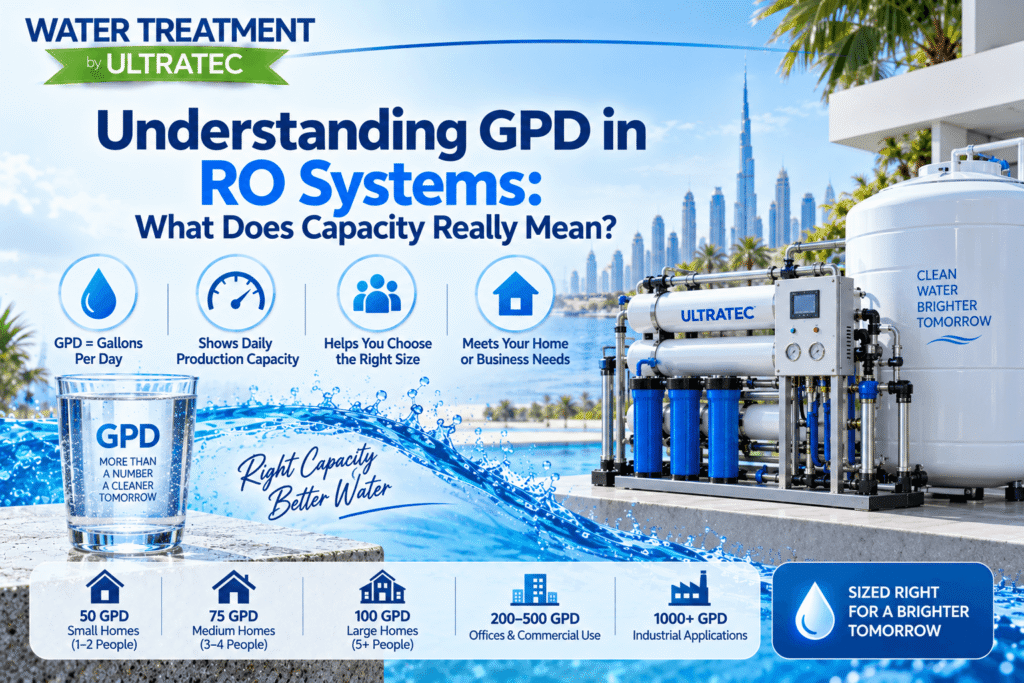
When you look at an RO system or RO membrane, you will often see numbers such as 50 GPD, 75 GPD, 100 GPD, 500 GPD, or 1,000 GPD. But what do these numbers actually mean? GPD stands for Gallons Per Day. In an RO system, it is mainly used to describe the rated water-production capacity of the membrane or system under specified operating conditions.
Understanding GPD is important because choosing a system only because it has a bigger number does not always mean it is the right choice. The required capacity depends on water demand, system design, pressure, temperature, and other operating conditions.
Table of Contents
ToggleWhat Is GPD in an RO System?
GPD, also known as Gallons Per Day, defines the volume of purified water that an RO membrane system produces within a day while subjected to its rated test parameters.
When a membrane with a 100 GPD rating operates, it delivers up to 100 gallons each day. Because one US gallon equals 3.785 liters, the system produces approximately 379 liters each day according to the stated conditions.
| GPD Rating | Approx. Litres Per Day | Typical Application |
| 50 GPD | 189 L/day | Small household use |
| 75 GPD | 284 L/day | Domestic RO systems |
| 100 GPD | 379 L/day | Higher household demand |
| 500 GPD | 1,893 L/day | Commercial applications |
| 1,000 GPD | 3,785 L/day | Larger commercial use |
GPD RO System Meaning: Capacity vs Actual Output
Systems are often misinterpreted by using the GPD measurement since it does not represent daily water production guarantees. Think of GPD only as an anticipated maximum the system can reach instead of continuous operational results. RO membranes are tested through controlled testing of pressure and temperature settings as well as feed-water conditions. Membrane production varies when the same changes are applied to feed-water conditions.
According to what we know, colder water tends to move slower through reverse osmosis membranes. Production decreases with lower pressure and feed-water quality, alongside membrane state impact system functionality.
| Factor | Effect on RO Production |
| Water pressure | Lower pressure can reduce output |
| Water temperature | Colder water generally reduces flow |
| Feed-water TDS | Higher dissolved solids can affect performance |
| Pre-filter condition | Blocked filters can restrict water flow |
| Membrane condition | Fouling or scaling can reduce production |
How Does RO System Capacity Work?
An RO system capacity reflects the total amount of purified water it can produce each hour or day. The complete system needs to be designed based on the higher output capacity or the capability to meet additional demand. All system components, including the membrane, pump, pre-treatment filters, pressure vessel, flow controls, and storage arrangement, must function as a coordinated unit. When a high-GPD membrane is installed without assessment of the pump and other elements, the system becomes unbalanced. The complete RO plant performance depends on factors beyond the membrane specification rating.
Is Higher GPD Always Better?
The answer is no. We cannot say that higher GPD is always better. As small households require only a limited amount of drinking water, they do not need a larger system, which adds unjustified expense and complication. Hotels, restaurants, offices, and industrial facilities handle higher demand.
The right capacity is the one that matches the actual water requirement.
| Requirement | Suitable Capacity Approach |
| Small household | Lower domestic GPD |
| Larger household | Medium domestic GPD |
| Office or small business | Commercial GPD based on demand |
| Restaurant or hotel | Higher commercial capacity |
| Industrial facility | Capacity calculated from process demand |
These are general examples rather than fixed rules. Actual sizing should be based on water consumption and system requirements.
How to Choose RO System Capacity
The first step is to calculate how much treated water you actually need. For a home, consider the number of people, daily drinking and cooking requirements, and whether the RO water will be used for any additional purposes.
For commercial and industrial systems, the calculation becomes more detailed. Daily consumption, peak demand, operating hours, recovery rate, and required treated-water quality all need to be considered.
A simple capacity calculation can help establish the starting point:
Required daily capacity = expected daily treated-water demand + suitable operating margin
The final RO system should then be selected according to the actual application rather than choosing the largest available GPD rating.
GPD in Domestic vs Commercial RO Systems
Domestic RO systems commonly use smaller membrane capacities, while commercial and industrial systems can require hundreds or thousands of gallons per day. The difference is not simply the size of the membrane. Larger systems may use multiple membranes, higher-capacity pumps, larger pre-treatment equipment, and different control arrangements.
A commercial RO plant producing hundreds or thousands of gallons per day needs a complete system designed for that workload.
GPD vs LPD: What Is the Difference?
GPD and LPD both describe water-production capacity, but they use different units.
GPD means Gallons Per Day, while LPD means Litres Per Day.
For example, a 100 GPD membrane has a rated capacity of approximately 379 litres per day when converting US gallons to litres.
| Rating | Approximate Equivalent |
| 50 GPD | 189 LPD |
| 75 GPD | 284 LPD |
| 100 GPD | 379 LPD |
| 500 GPD | 1,893 LPD |
| 1,000 GPD | 3,785 LPD |
The conversion helps when comparing RO equipment specified in different units.
Does GPD Tell You the Quality of RO Water?
It does not provide direct information. GPD shows the amount of production capability, but it does not measure the quality of the resultant water. The quality of water follows from membrane rejection capability alongside feed water specification settings, together with system pre-treatment methods and operation, equipment design, and upkeep methods.
A 1000 GPD membrane does not automatically remove contaminants better than a 500 GPD membrane. Review production capability and contaminant-blocking performance separately.
Why Correct GPD Selection Matters
Final Thoughts
When you compare RO membranes and water-treatment systems GPD works as the most beneficial figure to know. You get a daily production rating through this information, but there is more insight to be discovered. Actual output depends on pressure conditions and heat levels, together with feed-water quality, membrane condition, and entire system design elements.
When deciding how to choose RO system capacity, start with your real water requirement and then select equipment that can meet that demand under the expected operating conditions. A properly sized RO system is not necessarily the one with the highest GPD. It is the one that provides the required amount of treated water while working efficiently with the rest of the treatment system.
Frequently Asked Questions
What is GPD in an RO system?
GPD means Gallons Per Day. It indicates the rated amount of purified water an RO membrane or system can produce over 24 hours under specified conditions.
Is 100 GPD better than 75 GPD?
Not necessarily. A 100 GPD membrane has a higher rated production capacity, but 75 GPD may be sufficient where water demand is lower.
Why is actual RO output lower than the rated GPD?
Rated GPD is based on specific test conditions. Lower pressure, colder water, fouling, scaling, and other operating conditions can reduce actual production.
What does 500 GPD mean in an RO system?
A 500 GPD rating means the system or membrane has a rated capacity of 500 US gallons per day under its specified testing conditions.
